

Website feedback your AI agent can act on.
Draw, highlight, and comment on any live webpage, then share one link. A human reviews it in real time, or an AI agent connects over MCP and works it like a to-do list: acknowledge, fix, resolve, reply.
Try MarkLayer · Add to Chrome · Connect an agent · Build from source




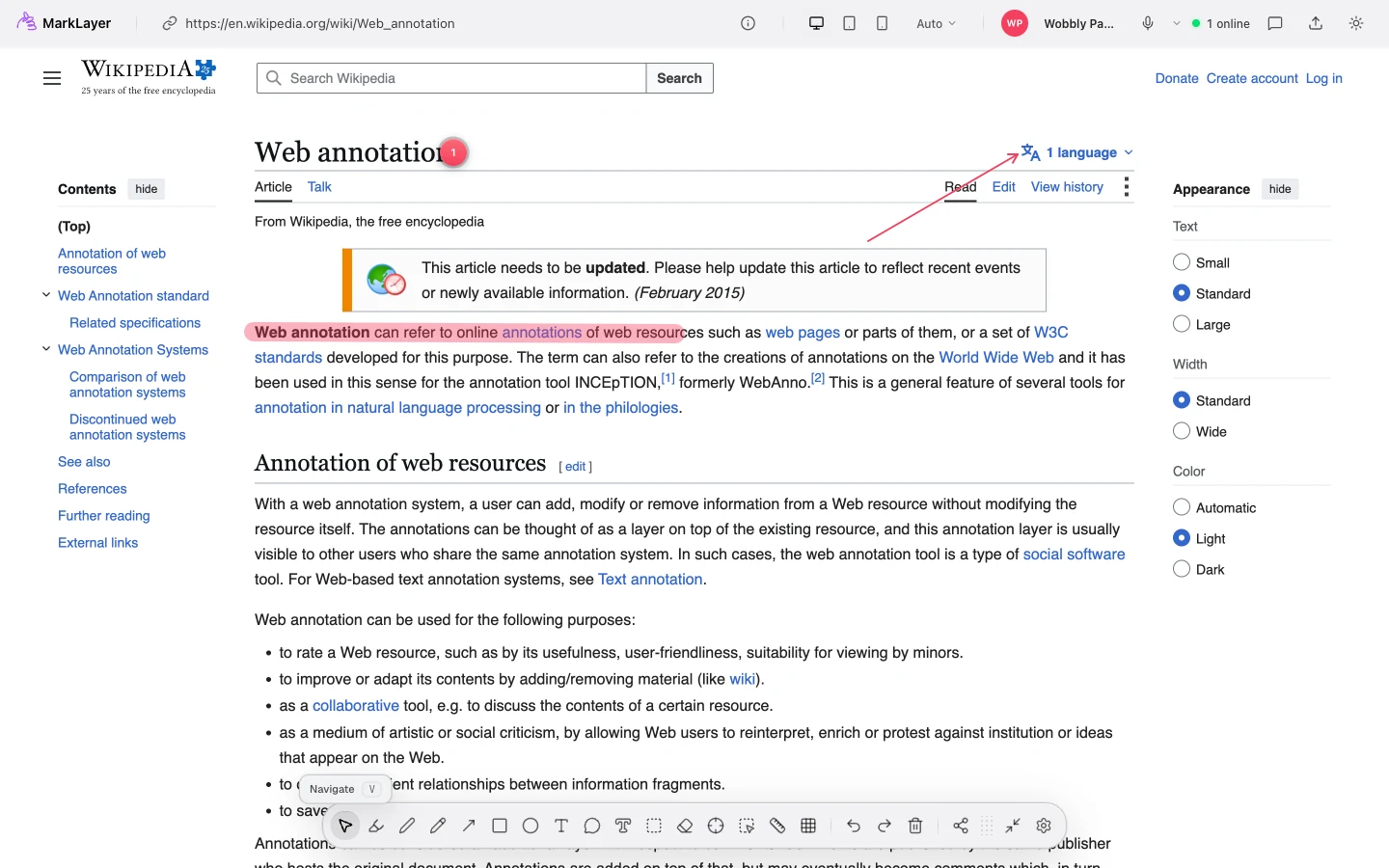
MarkLayer turns any webpage into a collaborative review surface. Instead of passing screenshots back and forth, send a link. Teammates or clients can open the original page in their own browser, leave feedback where it belongs, and see changes land live. So can an AI agent: each comment arrives with the exact element it refers to already attached.
- For AI-assisted work: give an agent the share link over MCP and it works the annotations as a live queue: acknowledge, fix, resolve. Nothing to install. Or inspect an element yourself for a stable selector and an AI-ready markdown snapshot.
- For client feedback: let clients point to exactly what they mean, without an account or extension.
- For design review: sketch ideas, highlight details, and keep the conversation attached to the page.
- For QA: pin reproducible issues to the actual UI, then share a clean link with the team.
- Open a page: paste any public URL at marklayer.app, or use the Chrome extension on the page you are already viewing — including a page on your own
localhostdev server, which never has to be reachable from the internet. - Make the feedback visible: draw, highlight text, measure space, pin a threaded comment, or inspect an element.
- Share one link: collaborators join the same board and see cursors, marks, replies, and calls in real time. Point an AI agent at the same link over MCP instead, and the thread becomes its work queue.
No sign-up. No trial clock. No client install.
| Send an agent to work the page | Every share link is also a remote MCP server, so an AI agent can watch annotations and acknowledge, fix, and resolve them live, or review the page and leave notes of its own. |
| Annotate freely | Pen, highlighter, eraser, shapes, arrows, text, and text-selection highlights. |
| Keep feedback in context | Pin threaded comments to the page, reply inline, and track status. |
| Review live | Real-time cursors, drawings, and comments via WebSocket, plus peer-to-peer voice and video chat. |
| Hand off agent-ready context | Inspect an element for a stable selector, computed styles, parent layout, viewport details, and framework component info, packaged as markdown built for a coding agent's prompt. |
| Measure the UI | Check element dimensions and edge-to-edge gaps between two elements. |
| Share or export | Create shareable links with preview cards, or export annotations to PNG. |
| Make it yours | Reorder toolbar tools; drafts persist locally and restore when you return. |
Every annotation is part of a structured queue: an agent can read it, act on it, and report back, the same way a human would.
Connect over MCP, with nothing installed. Every share link is also a remote MCP server. Add /mcp to it:
claude mcp add --transport http marklayer https://marklayer.app/s/<id>/mcpAny client that accepts a remote (Streamable HTTP) server URL takes the same address. Add ?agent=cursor, or any name, so the people in the room can see who is doing the work. The share panel on every link shows the command with the id filled in.
If a client only runs local servers, marklayer-mcp has the same tools as a stdio package, installed once for every room:
claude mcp add marklayer -- npx -y marklayer-mcpThen just ask: "Watch my MarkLayer annotations. For each one, acknowledge it, make the fix, then resolve it with a summary." The agent calls marklayer_watch_annotations in a loop, and the human watches every status change land live. It can go first, too: read_page hands it the page's text and controls with their selectors, so an agent asked to review a page leaves its own comments and suggests exact copy edits as diffs. The full toolset is documented in apps/mcp.
Every mark carries the context an agent needs. Inspecting an element captures its CSS selector, computed styles, parent layout, and framework component info as a markdown snapshot, so a comment arrives with the exact node attached instead of a vague description.
Or from inside the browser. On a browser agent with WebMCP support, the same list, acknowledge, resolve, and reply actions are exposed straight from the page via document.modelContext. Nothing to configure.
Agents can open their own boards, too. The share id is the access token, so minting a room is one unauthenticated POST, handy for seeding a review per URL ahead of time:
curl -X POST https://marklayer.app/api/$ID \
  -H 'Content-Type: application/json' \
  -d '{"ops":[],"url":"https://example.com","width":1440}'
Discoverable machine-first. /llms.txt, /llms-full.txt, /.well-known/api-catalog, an MCP server card, an agent skill, and a full OpenAPI spec describe the whole surface for an agent that's never seen MarkLayer before.
- No accounts or tracking: start reviewing immediately.
- Links expire thoughtfully: shared boards expire 90 days after their last view.
- Open source and self-hostable: MarkLayer is released under Apache-2.0, so your workflow is not tied to a pricing change.
Want the non-technical version? Read How MarkLayer works.
git clone https://github.com/thevrus/MarkLayer.git
cd MarkLayer
bun install
bun run dev
For the Chrome extension in development:
- Build or run the extension app.
- Open
chrome://extensions/and turn on Developer mode. - Choose Load unpacked and select
apps/extension/.output/chrome-mv3-dev.
├── apps/extension/         Chrome extension (WXT + Preact)
├── apps/worker/            Cloudflare Worker, API, real-time rooms, proxy, OG generator
├── apps/site/              Static marketing site (Astro)
├── apps/mcp/               MCP server for AI agents (published as marklayer-mcp)
├── packages/types/         Shared TypeScript types
└── packages/agent-tools/   Agent tool contract shared by the MCP server
| Area | Technologies |
|---|---|
| Frontend | Preact, Signals, Tailwind CSS, Vite |
| Extension | WXT, Chrome APIs |
| Backend | Cloudflare Workers, Hono, Durable Objects |
| Storage | D1 (SQLite), R2 |
| Real-time | WebSockets, WebRTC |
| Agent integration | MCP (remote at every share link, plus a stdio package), WebMCP, OpenAPI |
| Command | What it does |
|---|---|
bun run dev |
Run the workspace in development mode |
bun run build |
Build all apps |
bun run check |
Type-check the workspace |
bun run lint |
Lint and format-check with Biome |
bun run lint:fix |
Apply lint and formatting fixes |
cd apps/worker && bun run deploy |
Deploy the Worker to Cloudflare |
cd apps/mcp && bun run build |
Build the MCP server (marklayer-mcp) to dist/cli.js |
cd apps/site && bun run indexnow:submit |
Ping IndexNow (Bing and friends) after a deploy that changed pages |
Found a bug or have an idea? Open an issue. Contributions are welcome.
Apache License 2.0 © Dean Rusin
Try MarkLayer · Connect an agent · Add to Chrome · Report a bug · Request a feature