
██╗   ██╗ ███████╗ ██████╗  ██╗ ████████╗ ██╗   ██╗
██║   ██║ ██╔════╝ ██╔══██╗ ██║ ╚══██╔══╝ ╚██╗ ██╔╝
██║   ██║ █████╗   ██████╔╝ ██║    ██║     ╚████╔╝
╚██╗ ██╔╝ ██╔══╝   ██╔══██╗ ██║    ██║      ╚██╔╝
 ╚████╔╝  ███████╗ ██║  ██║ ██║    ██║       ██║
  ╚═══╝   ╚══════╝ ╚═╝  ╚═╝ ╚═╝    ╚═╝       ╚═╝
🌐 Live Demo: https://verity-iota-two.vercel.app
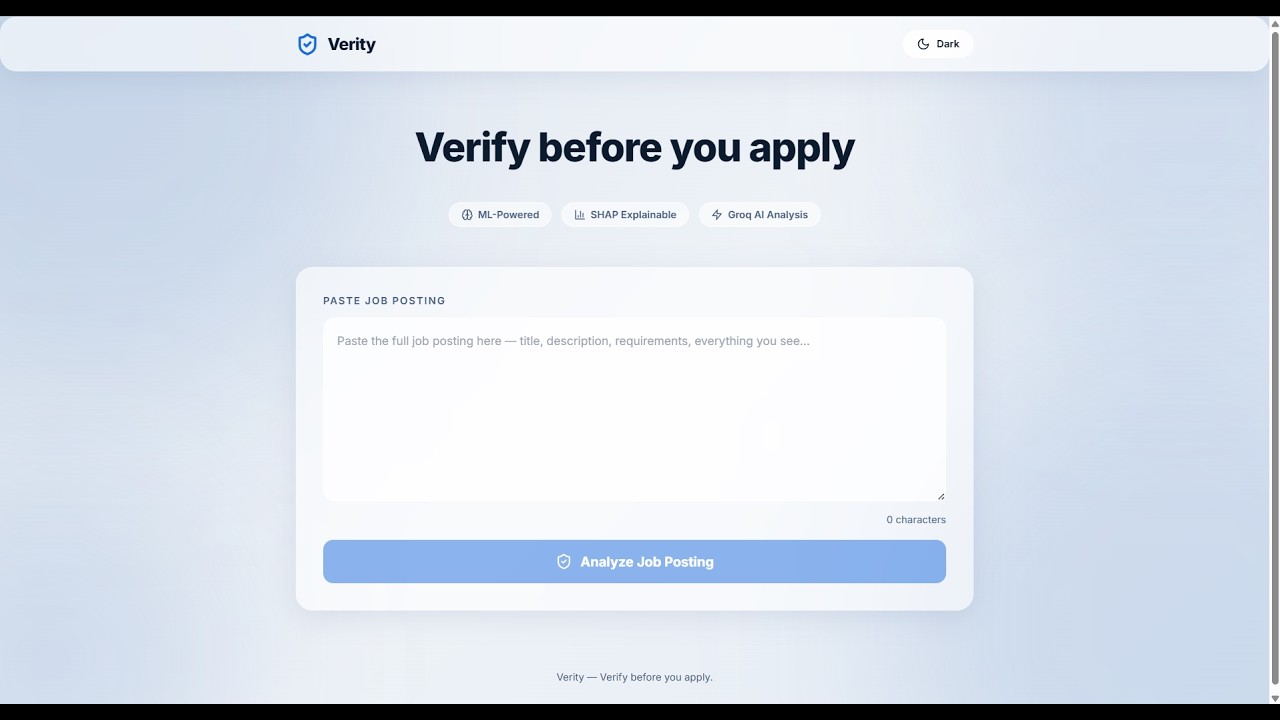
Verity is an ML-powered job posting fraud detector. Paste any job description and get an instant fraud verdict — backed by a real trained classifier (not just an LLM guess), with SHAP-based explainability and a Groq-powered natural-language breakdown of why a posting was flagged.
job text → TF-IDF + handcrafted features → LogisticRegression.predict_proba
         → SHAP top-10 features → Groq LLM → plain-English verdict → JSON response
- Feature extraction builds a 5010-dim sparse vector: 5000 TF-IDF features over
title + company_profile + description + requirements + benefits, plus 4 structural booleans (salary range, company profile, required experience, employment type) and 6 keyword-flag features (run-commands, download/install, crypto, wire-transfer, urgency, deposit). - Prediction: verdict is
SCAMifproba ≥ 0.4. - SHAP: top 10 features by
|shap_value|returned with direction. - Groq: top 5 SHAP features → 2-3 sentence explanation. Fails silently to
nullif Groq errors.
|
ML-Powered Trained classifier (Logistic Regression) scores every posting on real signal, not vibes |
SHAP Explainable Feature-level breakdown of exactly what drove the fraud score |
Groq AI Analysis LLM layer turns the model output into a readable, human verdict |
|
CORS-Locked API FastAPI backend restricted to the deployed frontend origin only |
Dark Mode Full light/dark theme toggle across the UI |
5000+ Feature Model Vectorized text features (TF-IDF) feeding the classification pipeline |
| Layer | Technology | Purpose |
|---|---|---|
| ⚛️ Frontend | React + Vite + TypeScript | Core UI framework and bundler |
| 🎨 Styling | Tailwind CSS + Framer Motion | Responsive design system + UI animation |
| 🗄️ Backend | FastAPI (Python) + Uvicorn | Async API serving the ML pipeline |
| 🤖 ML | scikit-learn (Logistic Regression) | Job posting fraud classification |
| 📊 Explainability | SHAP | Feature-level reasoning per prediction |
| 🧠 LLM | Groq API | Natural-language summary of the verdict |
| ☁️ Hosting | Render (API) + Vercel (Web) | Deployment |
Trained on the EMSCAD "Real or Fake Job Postings" dataset (~18k postings, ~5% fraudulent).
| Algorithm | Logistic Regression (calibrated) |
| Features | 5010 (5000 TF-IDF + 10 engineered) |
| ROC-AUC | 0.9895 |
| Explainability | SHAP (linear explainer) |
Training script: backend/ml_pipeline/train.py. A Random Forest path exists in predictor.py's SHAP branch for experimentation, but Logistic Regression is deployed.
Verity/
├── backend/
│   ├── app/
│   │   ├── routers/
│   │   │   └── analyze.py        # POST /analyze endpoint
│   │   ├── schemas/
│   │   │   ├── request.py        # Pydantic request models
│   │   │   └── response.py       # Pydantic response models
│   │   ├── services/
│   │   │   ├── feature_extractor.py  # Text -> ML features
│   │   │   ├── groq_client.py        # Groq LLM calls
│   │   │   └── predictor.py          # Model inference
│   │   ├── config.py
│   │   ├── dependencies.py
│   │   └── main.py               # App entry, CORS, router mounting
│   ├── ml_artifacts/             # Saved model + vectorizer
│   ├── ml_pipeline/              # Training scripts
│   ├── .env.example
│   ├── render.yaml
│   └── requirements.txt
├── frontend/
│   ├── src/
│   │   ├── components/
│   │   │   ├── Header.tsx
│   │   │   ├── HeroSection.tsx
│   │   │   ├── InputCard.tsx
│   │   │   ├── LoadingState.tsx
│   │   │   ├── ResultCard.tsx
│   │   │   └── Footer.tsx
│   │   ├── App.tsx
│   │   ├── main.tsx
│   │   └── index.css
│   ├── index.html
│   ├── tailwind.config.ts
│   └── vite.config.ts
└── README.md- Node.js (v18+ recommended)
- Python (v3.10+ recommended)
- A Groq API key
git clone https://github.com/smitdighe/Verity.git
cd Veritycd backend
python -m venv venv
venv\Scripts\activate
pip install -r requirements.txtCreate a .env file inside backend/ (use .env.example as a reference):
GROQ_API_KEY=your_groq_api_key
FRONTEND_ORIGIN=http://localhost:5173
Then start the backend server:
uvicorn app.main:app --reload --port 10000Backend API will be running at
http://localhost:10000Swagger Documentation available athttp://localhost:10000/docs
Open a new terminal session and navigate to the frontend folder:
cd frontend
npm install
npm run dev
Frontend will be running at
http://localhost:5173⚠️ Both the Vite server and the FastAPI server need to be running simultaneously for full functionality.
POST /analyze
// request
{ "job_text": "string" }

// response
{
  "verdict": "SCAM" | "LEGIT",
  "confidence": 0.0,
  "shap_features": [
    { "feature_name": "string", "shap_value": 0.0, "direction": "SCAM" | "LEGIT" }
  ],
  "explanation": "string | null"
}
GET /health — liveness check. Interactive docs at /docs when running locally.
- Render free tier: spins down after inactivity, can delay first request by 50s+
- Model trained on a single labeled dataset — accuracy varies on out-of-distribution postings
- No persistent storage for analysis history (stateless per request)
- Backend URL hardcoded in
App.tsxinstead of env var
- PDF/URL ingestion: Paste a job link or upload a PDF instead of raw text
- Session history: Store and revisit past analyses
- Model retraining pipeline: Periodic retraining on newer scam posting data