
Active Sessions is an Omeka S module that shows who is signed in to the admin side right now — from which address, on which device and browser, when each sign-in began and when it was last used — and lets a global admin sign any of them out (a lost phone, a shared computer, someone who has left).
- Omeka S 4.x · no other module required
- Works with Revision History when it is installed (see below)
- Licence: GPL-3.0-or-later (see
LICENSE) - Issues and questions: https://github.com/phumraphee/ActiveSessions/issues
After Sign out — the person's next click goes to the login page, and the sign-in is listed under Ended from this page with who ended it:
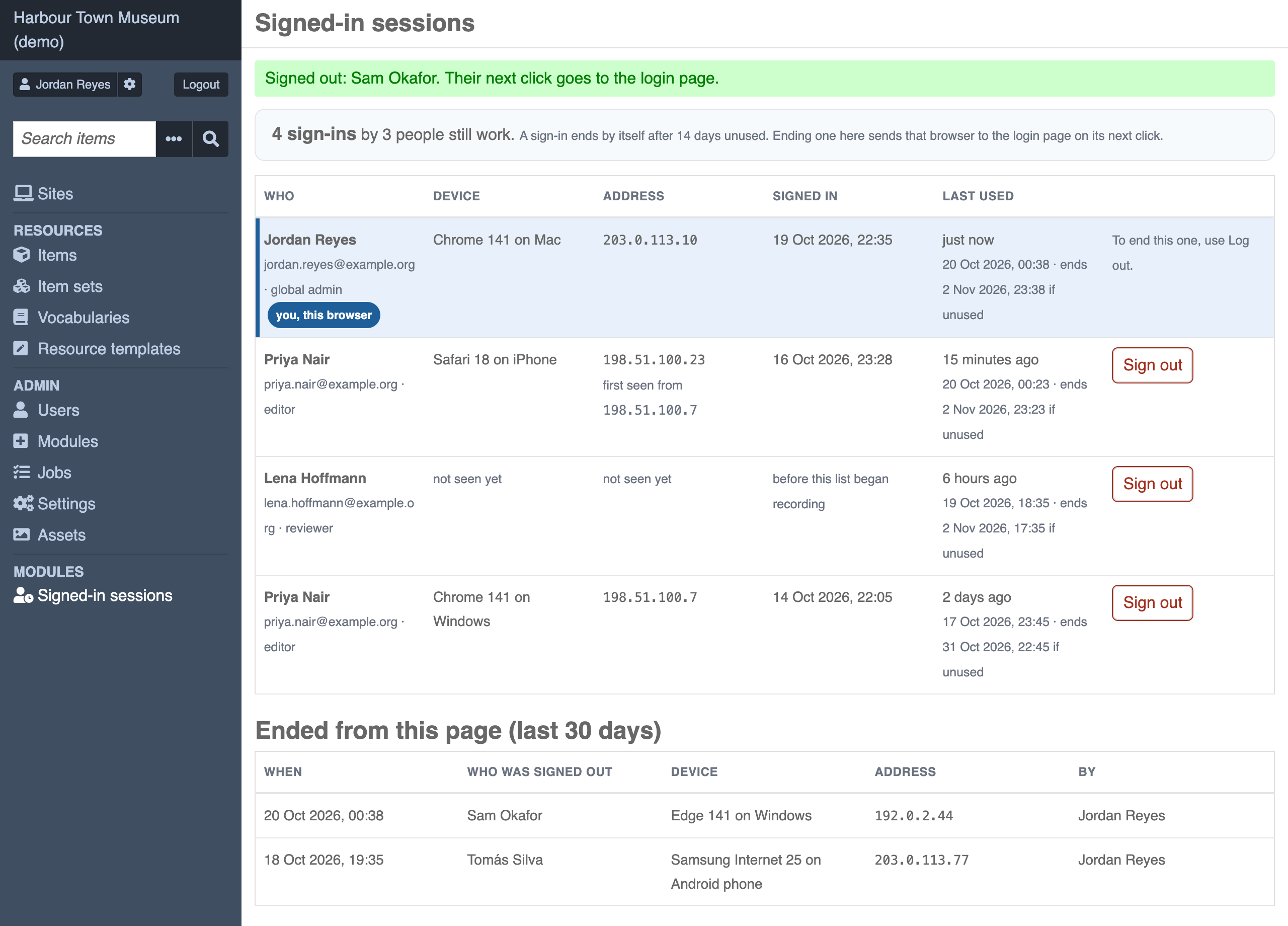
All screenshots are from a demo site with made-up people. The addresses are from the ranges set aside for documentation.
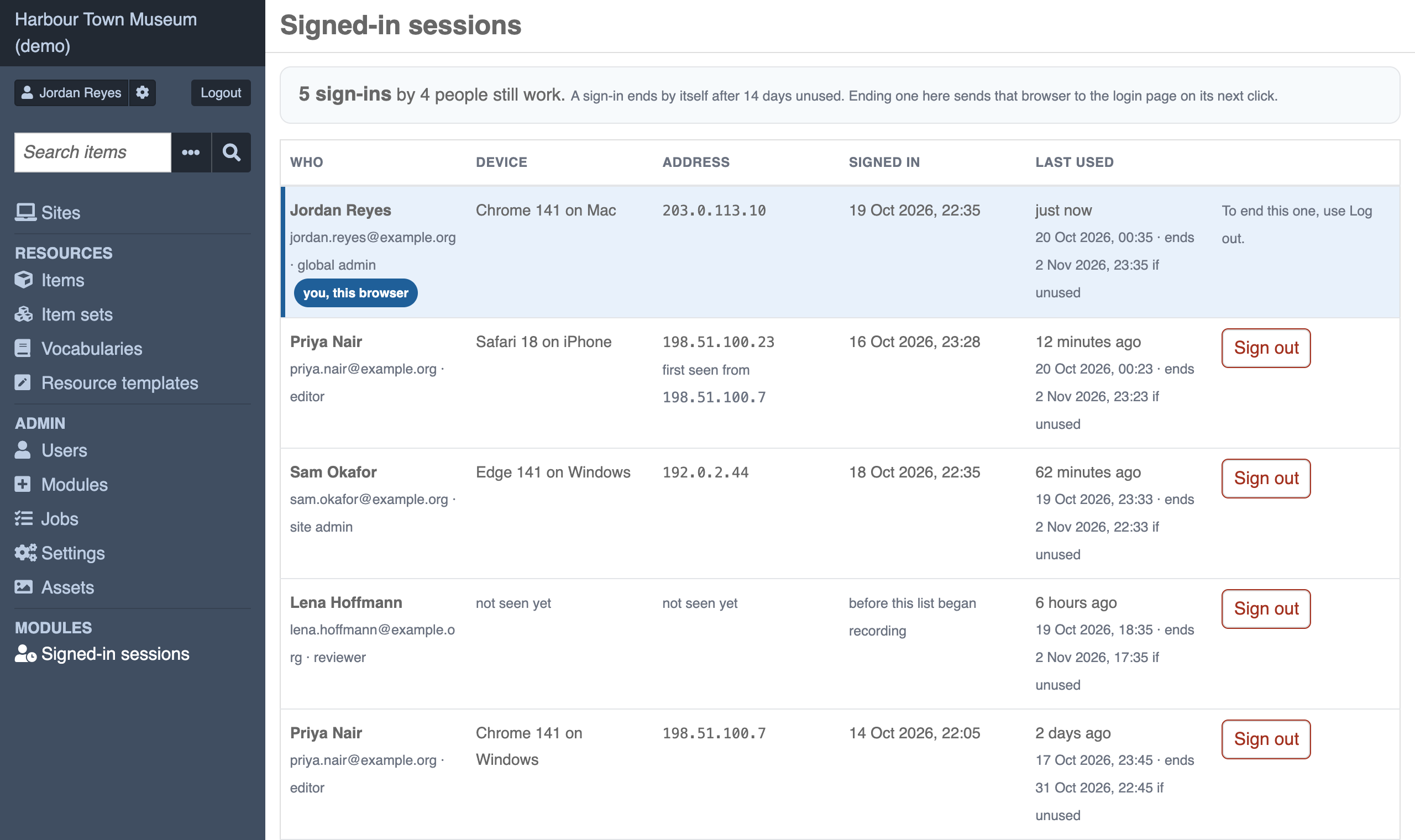
Admin → Modules → Signed-in sessions (/admin/active-sessions). Global admin only: any other
role gets page not found, as if the page did not exist, and a visitor the login page.
- Every sign-in that still works, yours first, then most recently used.
- Who — name, email and role. Device — the browser and system in words ("Safari 18 on iPhone"); hover for the browser's own description. Address — the latest one, and the first one when it has changed. Signed in — when this module first saw that sign-in. Last used — and when it will end by itself if nobody uses it.
- Sign out on every row but your own current one (for that, use Log out). The browser asks once before it is sent.
- Ended from this page (last 30 days) — when, whose, device, address, and by whom.
Omeka's own session table. Omeka keeps every PHP session in the database by default,
one row per session (id, data, last modified). A signed-in session is a row whose data holds
an account id under Laminas_Auth; everything else is a visitor. The list is read from there,
so a row there is a sign-in that still works, and nothing else is.
This module does not work if sessions are kept anywhere else. If
config/local.config.php sets a save_handler under session (files, Redis, Memcached…),
the session table is not used and there is nothing for this page to read. The page says so
at the top. Sessions in the table that have not been used for longer than the session lifetime
(session.config.gc_maxlifetime in local.config.php, otherwise PHP's
session.gc_maxlifetime) are not shown: PHP would throw them away anyway.
session has no address and no browser. Those come from this module's own table,
active_sessions_seen, written on the signed-in person's own requests:
- on every request of somebody signed in, one read by primary key; visitors cost nothing
- a write at most once a minute per sign-in, or at once when the address, the browser or the account changed; the first address is kept beside the latest
- requests signed with an API key are not sessions and are left alone
- sign-ins that began before the module was installed are listed at once, as not seen yet, and get their address and browser on their next request; their Signed in says before this list began recording
Nothing here can cost anybody a page: a failure is written to PHP's error log and the request goes on.
active_sessions_seen is keyed by the sha256 of the session id, never the id itself. The
id is all it takes to be that person, and a module's table gets exported, copied and backed up
on its own; a hash in it lets nobody sign in as anybody. The page and its forms carry only the
hash too.
- When the web server sees a public address, that address is kept, and the
CF-Connecting-IPandX-Forwarded-Forheaders are ignored: anyone could have written them. - When the web server sees a private address (10.x, 172.16–31.x, 192.168.x, and the like),
the request is taken to have come through a reverse proxy such as Cloudflare or a proxy on
the same network. The visitor's address is then read from
CF-Connecting-IP, or else from the first address inX-Forwarded-For.
If your Omeka is reached directly on a local network, with no proxy in front of it, a computer on that network can send those headers itself and have any address written down. The address is then only a hint. This is the same rule Revision History uses, copied rather than shared so that each works without the other.
A sign-in ends after a set time, by role: everybody 12 hours, the roles you choose
(global admin) 7 days — both in the module's settings (0 = no limit). The time is kept
on the server, not only in the cookie: each sign-in's clock (since in active_sessions_seen)
starts when the person logs in (Omeka's user.login event — the password form and modules that
sign in the same way), and
- on each of the person's requests, a sign-in past its time is signed out there and then (the login page says why);
- every few minutes, on anybody's request, every sign-in past its time is ended and its session
row deleted, so pages outside Omeka that read the
sessiontable see it gone too; - the session cookie is sent again to expire when the sign-in ends; a cookie kept longer by hand changes nothing.
0.3.1: the sweep also runs from cron, so it does not wait for somebody to open an Omeka page — every 5 minutes, as the web server's user:
*/5 * * * * php /path/to/omeka/modules/ActiveSessions/bin/sweep.php >> /path/to/omeka/logs/active-sessions.log 2>&1
It prints a line only when it ended a sign-in or forgot old records (those of sessions gone for over a week, as the sessions page does); exit 1 on an error. Without cron, the web sweep goes on as before.
Sign-ins that began before 0.2 (or before a change of the settings' roles) start their clock when first seen, so installing or upgrading never signs everybody out at once. The sessions page lists sign-ins ended this way with "Time limit" as who ended them. Its line at the top says the rule as set, and each sign-in says when it ends: its time limit, or unused, whichever comes first ("time limit starts at its next use" for one not seen since).
The session must live as long as the longest limit: gc_maxlifetime in
config/local.config.php ('session' => ['config' => [...]]) at least 7 days, or a sign-in
ends when PHP throws its session away; the settings page warns when it is shorter.
Two exceptions to the rule above, set by a global admin on the sessions page. Nothing set = 0.2 exactly.
- One person's own time — 7 days, 30 days, 180 days or the longest the server allows,
instead of their role's, for every device of theirs, from their next click (user setting
activesessions_user_limit). "As their role again" removes it. - One device kept — "Keep this device signed in longest" on a row of the list: that one
sign-in lasts the longest the server allows, from its sign-in; the same person's other devices
follow the rule. The row shows the device and browser, the address and when it was last used,
to tell devices apart. It is kept only while the person stays active and has the role they had
when it was set (
keep_role): a role changed or the person deactivated drops it, and their next request follows the rule again.
The longest the server allows is read as the site runs: the shorter of the session's lifetime
unused (gc_maxlifetime) and its cookie's (cookie_lifetime), from config/local.config.php
('session' => ['config' => …]), else PHP's. The page says it. Only the times shorter than it are
offered; a time set before the server's was shortened is cut to it, and the page says so. There
is no "for ever".
A device kept beats the person's own time, which beats the role. Sign out (one sign-in, or
"Sign out on every device" for one person) ends kept sign-ins too. An exception never lets in a
person Omeka has deactivated: their next request is signed out. Every change is in "Changes to
sign-in times" on the page (setting activesessions_log, latest 200).
Sign out marks the sign-in ended in active_sessions_seen first, then deletes its row
from session. The person's next click finds no session and goes to the login page. Their
other sign-ins (another browser, another device) are not touched.
A row that is written back. Omeka saves a session as each request ends, with
INSERT … ON DUPLICATE KEY UPDATE. So a request of that person's that was still running when
the row was deleted puts it back as it finishes, still signed in. The mark is what catches
that: on that browser's next request this module sees the sign-in was ended, signs it out
there and then, and that request goes to the login page. Until that next request the
written-back sign-in can appear in the list again; ending it again does no harm.
The form carries Omeka's own kind of token (valid for an hour), so a page from somewhere else cannot end a sign-in. A global admin cannot end their own current sign-in here.
Omeka keeps every session in its session table — a visitor's too, not only sign-ins. PHP is
meant to delete the ones unused for longer than gc_maxlifetime, but only when its own clean-up
runs, and many servers (Debian and Ubuntu among them) switch that off (session.gc_probability = 0).
Then the table only grows.
This module deletes those rows: bin/sweep.php does it on every run (cron, every 5 minutes), in
batches of 5,000; without cron, one batch an hour on somebody's page request. The cut is the
session's lifetime unused, so a sign-in that still works is never touched. The sessions page shows
the table — rows, size, the oldest — and when the clean-up last ran and how many rows it deleted.
Sign out everybody else ends every sign-in in the list but your own current one, kept devices too: after a password leak, or before work on the site. It is noted under "Changes to sign-in times".
Optional. When Revision History is installed,
a sign-in this module has not seen yet shows where that person last signed in, read from
Revision History's record of sign-ins (revision_history_event). It is the person's last
sign-in, not necessarily this session's, and the page says so. Without Revision History that
column just says not seen yet.
active_sessions_seen holds, per sign-in: the account id, the hash of the session id, the
first and the latest address, the browser's description, when it was first and last seen, and
— when it was ended from the page — when and by which account. Nothing is sent anywhere.
Rows are removed a week after their sign-in can no longer be alive (whenever the page is
opened). If your site must answer requests to remove personal data, include this table.
Drops active_sessions_seen. Omeka's own sessions are not touched: everybody stays signed in.
Omeka S 4.x, sessions in the database (Omeka's default). PHP 7.4+. MySQL 8 or MariaDB.
php tests/run.php— reading who a session holds from its data, the hash, browsers in words. No Omeka needed.tests/integration/— who may open the page, what is recorded and when, the address behind a proxy, and signing out (including a row written back), against a real Omeka.
Copyright (C) 2026 Phumraphee Sae-tang
This program is free software: you can redistribute it and/or modify it under the terms of
the GNU General Public License as published by the Free Software Foundation, either version 3
of the License, or (at your option) any later version. See LICENSE.