



Render an SVG to PNG, and read back what the renderer made of the document — the resolved tree, text metrics, paint, geometry. Node.js bindings for resvg 0.50, generated from the upstream Rust sources, so the TypeScript surface is usvg's own, names and doc comments included.
Try it in the browser — the same bindings compiled to WASI, rendering in the page, nothing to install.
npm install resvg-napiNode.js 20.3 or later. The WASI build, used where no native binary exists, needs
20.19+, 22.13+ or 23.5+: its emnapi runtime is ESM-only and the loader
requires it.
The WASI package declares cpu: ["wasm32"], so npm skips it on every real
host. Where no native binary matches — StackBlitz, WebContainer — ask for it:
npm install --cpu=wasm32 (yarn: supportedArchitectures.cpu). The same gate
makes a plain npm install resvg-napi-wasm32-wasi on x64 or arm64 fail with
EBADPLATFORM, and the browser entry (browser.js) needs that package: a
bundler build on such a host adds --force to that command, or installs
resvg-napi with --cpu=wasm32 and gives up the native package.
import { renderPng, parse } from 'resvg-napi/helpers'

renderPng(svg, { width: 1200, background: '#fff' })   // Buffer, system fonts, safe on untrusted SVG
const { tree, pendingImages, pendingFonts } = parse(svg, { fonts: ['Brand.ttf'] })
Two layers. resvg-napi/helpers is the short way, in JS: SVG in, PNG out,
guarded by default. resvg-napi is the crates themselves, one namespace
per crate (usvg, resvg, tiny_skia, fontdb, svgtypes), mirroring
their Rust API: read the Rust docs, call the same names in camelCase.
index.d.ts is the reference: it is generated, so it cannot drift. What
follows is the map. Coming from 0.9's Resvg class? See Upgrading from
0.9.
resvg-napi/helpers is plain JS on the raw API below, safe on untrusted input
by default.
import { renderPng, renderPngAsync, parse, renderNodePng, measureText } from 'resvg-napi/helpers'

renderPng(svg)                                         // Buffer, system fonts
renderPng(svg, { width: 1200, background: '#fff' })    // sized, on white
await renderPngAsync(svg, { scale: 2, signal })        // off the event loop

const { tree, pendingImages, pendingFonts } = parse(svg, {
  fonts: ['Brand.ttf', brandBytes],     // or a fontdb.Database; default: the system's
  images: { 'logo.png': logoBytes },     // tried first, by href
  resourcesDir: '/srv/templates',        // files only from here
})
renderPng(tree, { crop: { x: 0, y: 0, width: 100, height: 50 } })
renderNodePng(tree.nodeById('badge'), { scale: 4 })   // one element, sized to it
measureText('Ada Lovelace', { fontSize: 14, family: 'Inter' })
parse(svg, options?) · parseAsync |
{ tree, pendingImages, pendingFonts } |
renderPng(svg | tree, options?) · renderPngAsync |
PNG Buffer |
renderRaw(svg | tree, options?) · renderRawAsync |
{ width, height, data }, un-premultiplied RGBA8 |
renderNodePng(node, params?) · renderNodePngAsync |
one usvg.Node, in a PNG the size of its extent |
measureText(text, options?) |
the width a string draws at, in user units |
fitTextWidths(svg, options?) |
fit data-maxwidth text |
nodeExtent(node) |
where a node draws, { x, y, width, height }: a group's layer box, a shape's stroke box |
systemFonts() · systemFontsAsync() |
the shared system font database |
- Options.
usvg.Options(fontFamily,dpi,languages,resourcesDir,defaultSize...) plusfonts,imagesandresourcesRoot; a render takeswidth/height/scale,background(any CSS colour),crop(a{ x, y, width, height }, atiny_skia.Rector atiny_skia.NonZeroRect) andmaxPixelsin the same object. Given a parsed tree, a render ignores the parse options and leaves the tree as it was. - Safe by default. Every parse gets a fresh
guard.ImageHrefResolverandguard.FontResolver(Untrusted SVG): files only underresourcesDir, SVGZ refused with advice (SvgzFeatureNotEnabled, see Troubleshooting). Pass your own provider asimageHrefResolver/fontResolverto read itsmisses(). There is no unguarded parse here: for trusted SVG and usvg's own resolvers, parse withusvg.Tree.fromStrand hand the tree torenderPng. - Fonts. Without
fonts, the system fonts, scanned once and shared: on a worker thread by the async helpers, in place by the sync ones (the first sync call pays for the scan). Under WASI the system has none: passfonts. maxPixels(default 2^26, an 8192×8192 canvas) is checked before the canvas is allocated, so a document declaringwidth="200000"throws instead of aborting the process. A group with a filter or opacity renders through a layer of its own, which can be larger: raise it with care.- The async helpers take a
signal. A parse, a render and a PNG encode are one worker trip each.
The sizes are 0.9's Resvg.renderPng, to the pixel, for the same document and
params (test/helpers/). One deliberate difference: renderNodePng places a
group with a transform of its own where it draws, where 0.9 applied that
transform twice.
In a browser, the bundler's browser condition resolves resvg-napi/helpers
to a variant that loads no binding: build the set on the module the page
loaded.
import { createHelpers } from 'resvg-napi/helpers'
import * as binding from './resvg.js'   // the wasm loader
const { renderPng } = createHelpers(binding)
The package has an exports map: resvg-napi, resvg-napi/helpers and
resvg-napi/package.json. Other deep imports are closed.
One namespace per crate, each type under the crate that defines it, Rust names in camelCase. Rendering is Rust's loop:
import { usvg, resvg, tiny_skia, fontdb } from 'resvg-napi'

const db = new fontdb.Database()
db.loadSystemFonts()                                   // usvg's default database is empty
const tree = usvg.Tree.fromStr(svg, { fontdb: db, dpi: 192 })
const size = tree.size().toIntSize()
const pixmap = new tiny_skia.Pixmap(size.width() * 2, size.height() * 2)
resvg.render(tree, tiny_skia.Transform.fromScale(2, 2), pixmap)
pixmap.encodePng()                                     // Buffer
usvg |
Tree (fromStr, fromData, toString, root(), nodeById, the definition tables), the nodes (Group, Path, Image, Text, as a { kind, value } union), ClipPath, Mask, Pattern, the paint servers and filters, Options and WriteOptions as plain objects |
resvg |
render(tree, transform, pixmap), renderNode(node, transform, pixmap) |
tiny_skia |
Pixmap (encodePng, decodePng, data, takeDemultiplied, pixel, cloneRect...), Transform, Rect, NonZeroRect, IntRect, Size, IntSize, Point, Color, ColorU8, PremultipliedColor, PremultipliedColorU8; a path's segments |
fontdb |
Database (loadSystemFonts, loadFontData, loadFontFile, loadFontsDir, faces(), the generic-family setters), FaceInfo |
svgtypes |
Color.fromStr, CSS colours as an SVG attribute reads them |
guard |
ImageHrefResolver, FontResolver: the untrusted SVG opt-in, resvg-napi's own |
| root | setLogLevel, takeLogs (Warnings and logs) |
- Options are plain objects: every field optional, the rest from Rust's
Default, sousvg.Optionsleft out means an empty font database, as in Rust: text then draws nothing. Fields with no JS form take a class instance:fontdbafontdb.Database,defaultSizeatiny_skia.Size(tiny_skia.Size.fromWh(w, h)), the resolvers theguardclasses. - Classes.
newis the constructor, and throws where Rust returnsNone; every otherOptionisnull. Plain-data classes (Transform,Point,svgtypes.Color) havefromObject/toObject;FromStrisfromStr,DisplayistoString. A Rust tuple is an array (dimensions()is[w, h], a face'sfamilies[name, language]pairs). - Errors. A
Resultthrows anErrorwhosecodeis the Rust variant's name and whosemessageis itsDisplay, typed per enum (usvg.ErrorCode:NotAnUtf8Str,SvgzFeatureNotEnabled,MalformedGZip,ElementsLimitReached,InvalidSize,ParsingFailed). - Async twins, a worker thread each, with an
AbortSignallast:usvg.Tree.fromStrAsync/fromDataAsync/toStringAsync,resvg.renderAsync/renderNodeAsync,tiny_skia.Pixmap.encodePngAsync,fontdb.Database.loadSystemFontsAsync/loadFontsDirAsync. A pixmap an async call draws on is in use until it settles: any other use throwsLeased. dispose()on every class frees its value now instead of at garbage collection; any later call throwsDisposed.using x = …calls it at the end of the block, on runtimes withusing(Node 24, Chrome 134, Firefox 141). WhereSymbol.disposeis missing (iOS Safari at the time of writing), calldispose()yourself.- The raw API behaves like Rust: a huge
new tiny_skia.Pixmap(w, h)aborts the process on the failed allocation, and usvg's default resolvers read any path. The helpers check both.
tree.toString() hands back the resolved tree with the text converted to
paths — an SVG that draws the same where the font is not installed, which is
what a print or PDF pipeline needs from a template:
const { tree } = parse(svg, { fontFamily: 'DejaVu Sans', fonts })
tree.toString()                        // one <path> per glyph, no <text>
tree.toString({ preserveText: true })  // <text> kept, resolved but not outlined
tree.toString({ indent: 'none' })      // one line; also a number of spaces, or 'tabs'
await tree.toStringAsync()             // off the event loop
The outlines come from the same layout renderPng draws, so a glyph sits where
the raster puts it — and its stroke box measured it before either.
The tree is usvg's: usvg.Tree.fromStr (or the helpers' parse) parses,
tree.root() is the root usvg.Group, and group.children() and
tree.nodeById(id) hand back usvg.Nodes, { kind, value } objects that
TypeScript narrows on kind:
import { usvg, fontdb, tiny_skia, resvg } from 'resvg-napi'

const db = new fontdb.Database()
db.loadSystemFonts()                      // usvg's default database is empty
const tree = usvg.Tree.fromStr(svg, { fontdb: db })
const n = tree.nodeById('surname')        // { kind: 'group' | 'path' | 'image' | 'text', value }
if (n?.kind === 'path') n.value.fill()    // fill, stroke, data(), boxes
if (n?.kind === 'text') n.value.chunks()  // chunks, layouted spans, positioned glyphs, decoration
if (n?.kind === 'group') n.value.opacity() // transform, blendMode, isolate, filters…
Like usvg's in Rust, these options read any local path an <image href>
names: parse untrusted SVG with the guard providers (Untrusted
SVG).
Each value keeps its tree alive and finds its node again on each call, so it
outlives the tree variable. text.flattened() is that text's glyphs as a
group of paths, the outlines renderPng draws. A span carries what it is drawn
with, down to the lines through it:
const span = n.value.chunks()[0].spans[0]
span.decoration.underline?.fill?.paint  // …and .overline, .lineThrough
Definitions hold nodes too: tree.patterns(), tree.masks() and
tree.clipPaths() (or group.clipPath(), group.mask()) each have root(),
the group of their content. What an feImage primitive draws, and the
document an <image> embeds, are not reachable yet.
resvg.renderNode(node, transform, pixmap) draws one node on a
tiny_skia.Pixmap, as Rust's resvg::render_node does: in the node's own
coordinates, offset by its layer box. The helpers' renderNodePng sizes and
places it for you.
A path's geometry is what Rust's path.data().segments() iterates:
tiny_skia_path::PathSegment as a union, one point or an array of them per
segment, each point a plain { x, y } (tiny_skia.PointObject):
path.data()
// [{ type: 'moveTo', value: { x: 10, y: 10 } },
//  { type: 'quadTo', value: [{ x: 60, y: 30 }, { x: 30, y: 50 }] },
//  { type: 'close' }]
A tiny_skia::Path cannot be a class of its own here: usvg.Path has that
JS name, and napi keeps one constructor per class name.
Paint is a discriminated union, so TypeScript narrows it:
const paint = n.value.fill()?.paint
if (paint?.type === 'color') paint.value   // { red, green, blue }
else paint?.id // the gradient or pattern it namesThe raw API behaves like Rust: without a resolver, usvg reads any local
path an <image href> names (/etc/…, ../, a FIFO) and decodes any image,
however large it says it is. The guard providers are the opt-in that does
not, and every helper that parses caller SVG uses them:
import { usvg, guard } from 'resvg-napi'

const images = new guard.ImageHrefResolver({
  images: { 'logo.png': logoBytes }, // tried first, by href
  resourcesDir: '/srv/templates',    // files only from here (resourcesRoot widens it)
})
const fonts = new guard.FontResolver()
const tree = usvg.Tree.fromStr(svg, { fontdb: db, imageHrefResolver: images, fontResolver: fonts })
images.misses() // hrefs nothing resolved: ['photo.jpg']
fonts.misses()  // named families the database lacks: ['Brand Sans']
guard.ImageHrefResolver reads files only under resourcesDir (its own, or
the parse options'; with neither, none), canonicalised so .., absolute paths
and symlinks cannot leave it, and only regular files of at most 256 MiB,
opened without following a final symlink. Whatever the source, it refuses
gzip data (SVGZ) and any raster image whose header declares more than 2^28
pixels, and logs the refusal. The async twins (fromDataAsync,
fromStrAsync) carry the resolvers to the worker thread; misses() reads
what they recorded once the promise settled. Use one instance per parse: one
shared between parses lists the misses of them all.
The parse option maxDepth (default 1024) is the only bound on how deep
usvg recurses into nested elements. Leave it alone on untrusted SVG: a much
larger value lets a deeply nested document overflow the stack, which aborts
the process, sooner on a worker thread (*Async) or in the browser.
Every node reports boundingBox(), absBoundingBox(), strokeBoundingBox()
and absStrokeBoundingBox() (a tiny_skia.Rect), and a group
layerBoundingBox() and absLayerBoundingBox() (a tiny_skia.NonZeroRect)
— in the document's own units, which is not the canvas. A group's or a
path's box is null when it has none: an empty group, a box that overflows. Their sides are
methods: box.width(). nodeExtent(node) from resvg-napi/helpers is where
a node will draw, as a plain { x, y, width, height }: a group's layer box, a
shape's or a text's stroke box. See Fitting text to a
width for why the units bite.
fontdb.Database is fontdb itself: loadSystemFonts(),
loadFontData(buffer), loadFontFile(path), loadFontsDir(dir), faces(),
and the generic-family setters. A fontdb.FaceInfo reports its families
([name, language] pairs, English (US) first: face.families[0][0] is the
name fontFamily takes), postScriptName, weight, style ('normal' | 'italic' | 'oblique'), stretch and whether it is monospaced. A parse
shares the database rather than copying it; writing to it afterwards copies
it first. The helpers' pendingFonts names the families a document wanted
and did not get; pendingImages does the same for hrefs.
A face is named by its fontdb.ID (face.id): db.face(id),
removeFace(id), withFaceData(id) ([bytes, index]), faceSource(id).
db.query({ families: [{ type: 'name', value: 'IBM Plex Sans' }], weight: 700 })
returns the best match's ID, familyName(family) resolves a generic family,
and loadFontSource({ type: 'binary', bytes }) loads and returns the new
IDs. A rendered glyph's font is the ID of the face that drew it.
tree.linearGradients(), radialGradients(), patterns(), clipPaths(),
masks(), filters() — the paint servers an element's id refers to.
Four templates in demo/examples/, each rendered by
node demo/render.mjs <template.svg>: Liquid fills the template from the JSON
file next to it, this binding rasterises the result. The images below are that
command's output.
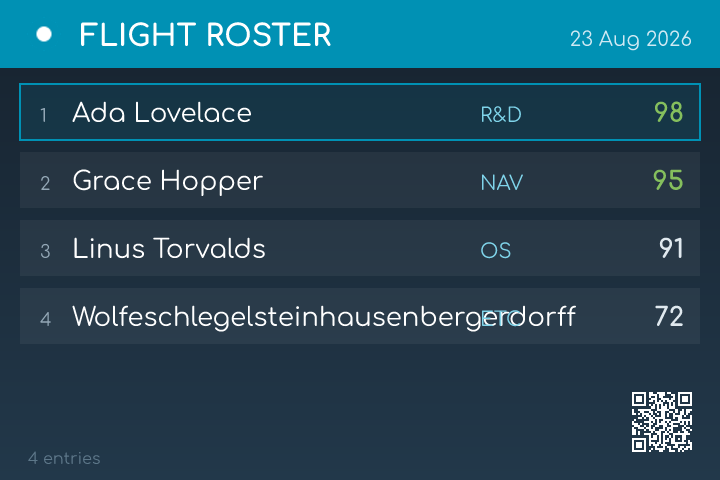
A staff array becomes rows, with an embedded logo and a QR code generated
during templating. The fourth name runs straight into the column beside it —
measuring that overflow, and compressing it away, is what Fitting text to a
width below is for.
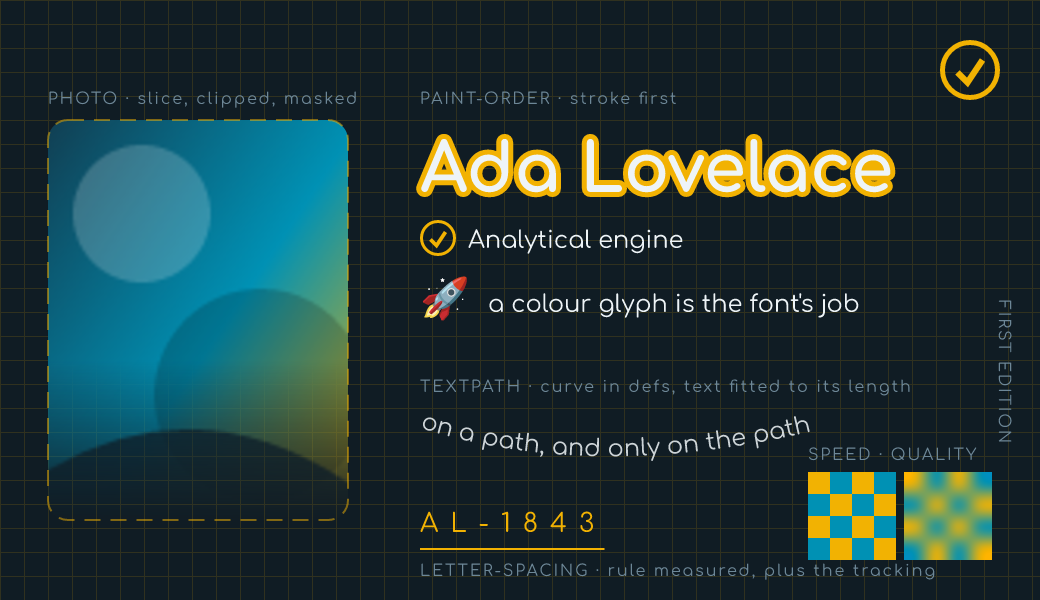
Everything a card does with raster images and type, and nothing it does with data.
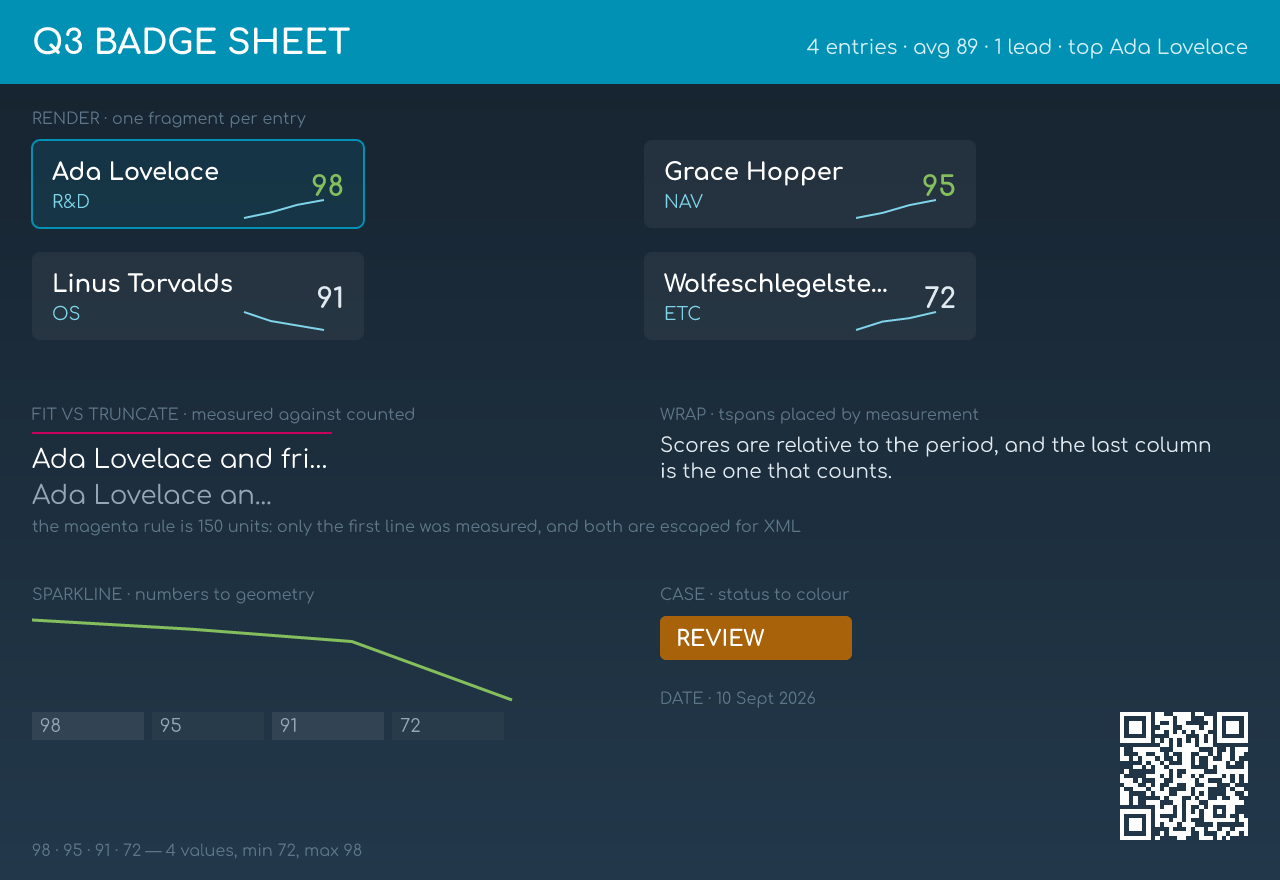
Pulls badge.svg in as a partial and repeats it. A guided tour, where every zone
of the page is one Liquid capability.
sheet.svg covers the data half — pagination, grouping, theming, and
--lang fr driving <switch systemLanguage>, which usvg picks nothing from
without a language.
resvg's own test corpus, rendered through these bindings: 1715 of 1715 match
the reference PNGs upstream asserts on, within 1/255 per channel — a tolerance
measured rather than chosen, with the reason recorded in
scripts/conformance.mts.
npm run conformance:fetch   # the corpus, at the tag Cargo.lock builds
npm run conformance         # 15 seconds including the fetch
CI runs it on every pull request, so a resvg bump that changes a render shows up as a diff rather than passing unnoticed.
Thirteen targets.
| x64 | arm64 | armv7 | ia32 | |
|---|---|---|---|---|
| Linux (glibc) | ✅ | ✅ | ✅ | — |
| Linux (musl) | ✅ | ✅ | — | — |
| macOS | ✅ | ✅ | — | — |
| Windows (MSVC) | ✅ | ✅ | — | ✅ |
| Android | — | ✅ | ✅ | — |
WASI (wasm32-wasip1-threads) |
✅ | — | — | — |
The dependency tree is pure Rust — fontconfig support comes from
fontconfig-parser, not the C library — so every target cross-compiles without
a system SDK.
The WASI build is the same generated bindings on emnapi instead of node-api, and
it is complete: rendering, toString, bounding boxes, the node walk, the async
twins (threads via wasm32-wasip1-threads) and even filesystem image
resolution all work. Two differences: loadSystemFonts() finds 0 faces inside
the sandbox, so fonts must be supplied with loadFontFile(path),
loadFontsDir(dir) or loadFontData(buffer) — the demo fetches them from
google/fonts by name rather than making you find a file; and WASI has no mmap,
so font files are read into memory.
Adding a target is the triple in package.json under napi.targets; then
npm run create-npm-dirs. CI builds that list, and scripts/ci-targets.mts
derives which host builds each triple and which cross-compilation flag it needs.
CI does not build all thirteen on a pull request. It builds the two that can
tell it something — x86_64-unknown-linux-gnu, which the tests, the drift
checks and the conformance suite run on, and wasm32-wasip1-threads, whose
generated shims and test run are a different code path. The other eleven build
on the merge, on a v* tag, on a manual dispatch, or on a pull request labelled
full-matrix when the proof is wanted before merging rather than after.
An Illustrator template says how wide a field may be on the element itself
(data-maxwidth="85"), which is not SVG — resvg drops it. fitTextWidths reads the
constraint from the source, measures the text with nodeExtent on the
usvg.Tree you parse it with, and compresses the element horizontally, composing a
scale(k 1) onto whatever transform it already has (the same device those
templates use by hand):
import { fitTextWidths } from 'resvg-napi/helpers'

const { svg, adjustments, problems } = fitTextWidths(source,
  { fontFamily, fonts: db, resourcesDir, images })
// adjustments: [{ id: 'surname', from: 200.23, to: 90, factor: 0.4495, measured: 90.0031 }]
Each pass parses as the helpers' parse does, through the guard (see
Untrusted SVG). A render function, (s) => usvg.Tree,
works in place of the options; guardedParse(binding, options) is one that
keeps the guard. A plain (s) => usvg.Tree.fromStr(s, …) works too, but
without a resolver usvg resolves <image href> from any local path, as it
does in Rust: only for trusted SVG.
The limit is read in the document's own units, the ones the attribute is
written in. That matters: width="85.6mm" with a viewBox 240.94 wide makes usvg
normalise the tree to 323.53 units, so an extent comes back 1.343× larger than
anything the file says. Comparing raw canvas widths compresses text that actually
fits — everything past limit / 1.343.
No id needed: an element that has none gets one generated, numbered in document
order, so the constraint does not depend on the template carrying ids. The scale
is anchored at the element's own x — a bare scale() is anchored at the origin
and slides the text left as it narrows.
A geometric scale is exactly linear in width, so one pass lands on the target;
the second measurement is a check, and it is reported. Text that already fits is
left untouched, and a constraint that cannot be honoured says why: no id to
measure by, no visible extent, or an unusable width. It compresses glyphs rather
than reducing font-size — the choice the templates already made.
usvg and resvg report every recoverable problem through the log crate —
unparsable values, skipped shapes, unmatched font families, images that could not
be read. Nothing consumes that by default, so those messages used to vanish:
import { setLogLevel, takeLogs } from 'resvg-napi'
import { renderPng } from 'resvg-napi/helpers'

setLogLevel('warn')            // off | error | warn | info | debug | trace
renderPng(svg)
takeLogs()
// [ "WARN usvg::parser::style: Failed to parse fill value: 'notacolour'. Fallback to black.",
//   "WARN usvg::parser::shapes: Rect '' has an invalid 'width' value. Skipped." ]
takeLogs() drains the buffer, which is capped at 500 entries so a pathological
document cannot grow it without end. A full buffer ends with a
WARN napi_support::logs: log buffer full (500 entries), later messages dropped
line. It collects from every call and thread, worker threads included, so
concurrent renders interleave there. (0.9 also kept each Resvg's own; that
went with the class.)
A font family did not apply. pendingFonts from the helpers' parse (or
a guard.FontResolver's misses()) names the families the document asked for
and did not get. Supply them as fonts (files or buffers), or with
loadFontFile(path) or loadFontData(buffer) on your fontdb.Database,
before parsing. Under WASI, loadSystemFonts() finds nothing inside the
sandbox, so every face has to be loaded by hand.
An image did not appear. pendingImages names the hrefs that could not be
resolved. Files are read from disk only below resourcesDir: an absolute path,
a .. or a symlink leading out of it is refused, and without resourcesDir the
disk is not read at all. resourcesRoot widens the fence to an ancestor, so a
template can still reach ../assets/logo.png; or hand the bytes over as
images instead. Bytes fetched after the parse go back by parsing again with
them in images. Refused, because each
would otherwise be allocated in full: a file of more than 256 MiB, SVGZ (see
below), and a raster image whose header declares more than 2^28 pixels. An
image refused this way, or supplied bytes that are not an image at all, is
listed in pendingImages (a data: URI is only logged).
An .svgz file throws SvgzFeatureNotEnabled. SVGZ is not supported for
now: usvg inflates gzip with no size limit, so a few hundred bytes can expand
to gigabytes (linebender/resvg#1138).
Inflate it yourself, with a limit you choose, and pass the result:
import { gunzipSync } from 'node:zlib'
const png = renderPng(gunzipSync(svgz, { maxOutputLength: 64 << 20 }))
In a browser, DecompressionStream('gzip') does the same; stop reading past
your limit. An SVGZ <image> inside a document is not drawn.
A measurement disagrees with the numbers in the file. Bounding boxes are in the document's own units and usvg normalises the tree, so they are not canvas pixels. See Fitting text to a width for the arithmetic.
Something was dropped and nothing said so. usvg reports it through the log
crate and nothing consumes that by default — see Warnings and
logs.
A member is missing from the TypeScript surface. The generator keeps a report
of every upstream member it left alone, with the reason.
RESVG_NAPI_CODEGEN_LOG=1 cargo build prints it, and
CONTRIBUTING.md explains what the reasons mean.
Not sure which binding loaded. __napiBindingTarget names it: 'native'
for a platform addon, otherwise the WASI flavour. That separates a machine that
fell back to wasm32-wasi — where loadSystemFonts() finds nothing — from
one running the native addon, and reports what NAPI_RS_NATIVE_LIBRARY_PATH
resolved to when it is set, since the loader adopts the override's own target
rather than claiming 'native'.
0.11 maps usvg.Font.families, so usvg.Font, usvg.TextSpan and
usvg.TextChunk are plain objects now: the same properties, read the same
way, but no instanceof, dispose() or disposed.
0.10 removed the hand-written Resvg class and the other flat exports
(ADR 0001). What replaces each:
| 0.9 | 0.10 |
|---|---|
new Resvg(svg, options, fonts, images) |
parse(svg, { ...options, fonts, images }) (helpers), or usvg.Tree.fromStr(svg, options) |
Resvg.parseAsync · renderAsync(svg, options, params) |
parseAsync · renderPngAsync(svg, { ...options, ...params }) |
doc.renderPng(params) · renderRaw (and …Async) |
renderPng(tree, params) · renderRaw (and …Async), or resvg.render on a tiny_skia.Pixmap |
doc.toString(opts) · toStringAsync |
tree.toString(opts) · tree.toStringAsync |
doc.width · doc.height |
tree.size().width() · .height() |
doc.absLayerBoundingBox() and the other boxes |
tree.root().absLayerBoundingBox(): a tiny_skia.NonZeroRect or null, sides as methods |
doc.pendingImages() · pendingFonts() |
pendingImages · pendingFonts from parse, or a guard provider's misses() |
doc.resolveImage(s) |
parse again with the bytes in images |
doc.takeLogs() (per document) |
takeLogs(), global |
doc.dispose() |
tree.dispose(), on every class |
FontDatabase · FontFace |
fontdb.Database · fontdb.FaceInfo (families are [name, language] pairs) |
FontDatabase.query · faceData · familyName · faceSource |
query · withFaceData · familyName · faceSource (0.11), by fontdb.ID |
RenderOptions · WriteOptions |
usvg.Options · usvg.WriteOptions; defaultSizeWidth/Height is defaultSize: tiny_skia.Size.fromWh(w, h) |
RenderParams · RawImage |
the helpers' RenderParams · RawImage |
BBox · Dimensions · Matrix |
tiny_skia.NonZeroRect or Rect · tiny_skia.Size · tiny_skia.Transform |
PathSegment ({ type, points }) |
the tiny_skia.PathSegment* union ({ type, value }, points as { x, y }) |
ParseErrorCode |
usvg.ErrorCode |
resvg-napi/fit.mjs |
resvg-napi/helpers |
The same bindings compiled to WASI, in the browser: a simple page (edit an SVG,
see the PNG resvg draws, copy the Node.js call) and, behind it, a proof bench
with Liquid templating, an array editor, per-element export and live
diagnostics. Deployed from main at
p8nut.github.io/resvg-napi, and it
runs locally too:
npm run demo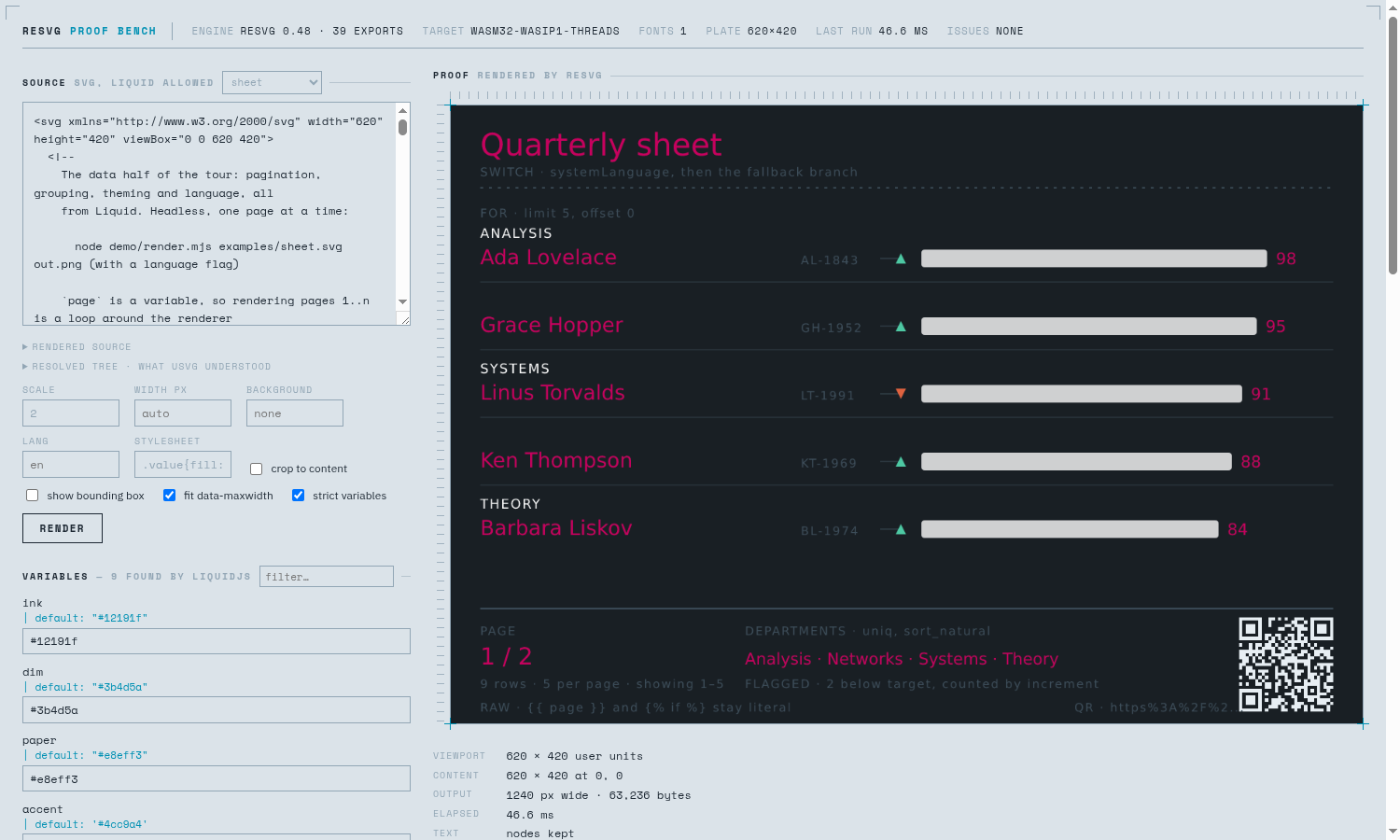
demo/README.md describes the page.
CONTRIBUTING.md — how the bindings are generated, and what to read before touching the generator.
Apache-2.0 OR MIT, matching resvg.