Repository navigation
FEAT: Let users pick a server credential for a target (part 19) - #4070
Open
varunj-msft wants to merge 176 commits into
Open
varunj-msft wants to merge 176 commits into
varunj-msft wants to merge 176 commits into
Conversation


…API input

External construction now rejects a parameter whose type includes Path unless the
calling service passes the name in allowed_path_params after making the value safe.
The converter service allows its upload parameters once they are stored, and the
target service allows the server-set upload folder and the GitHubCopilotTarget
working directory. The scorer-only check is removed, and the "Valid parameters"
list leaves out path parameters callers cannot set.
The target catalog now applies the path rule to required parameters too, so a
target that needs a disallowed path is left out instead of listed without the
field, matching the scorer catalog. allowed_path_params is typed frozenset[str]
so a bare string cannot turn the allow-list into a substring match.
The target catalog still lists a target whose required path parameter is its
server-set upload folder when the server has one, and leaves it out otherwise.
# Conflicts:
#	tests/unit/backend/test_converter_service.py
…benchmark's recipes folder
 varunj-msft
changed the title
FileDocumentStorage now raises DocumentStorageUnavailableError when the
folder or container can't be used, and DocumentUnreadableError when one
document exists but can't be read. The message names the location, with
any SAS token hidden, and a short reason. One backend handler maps both to
503 and logs the location and reason, with the traceback at debug level,
so the per-route storage helpers are gone.

A single read, a conditional save and a delete now follow the listing's
rules: a folder, pipe or broken link named like a document is unreadable
rather than missing, and on Blob only a deleted blob counts as missing.
Blob sign-in, permission, network and missing-container errors stop the
listing instead of marking every file unreadable. Each unreadable report
keeps the real file name and the original error, and the listing's
documents are read-only.

Initializer delete removes a script that can't be read or decoded, and
registering one no longer turns a storage write failure into a 400.
Tests patch module-level aliases instead of os.
List recipes escapes the OS text it reports, such as a file name that
isn't UTF-8, and a recipe whose JSON holds an unpaired surrogate escape
is reported as invalid, so the models no longer need a JSON-only
serializer. Recipes may start with a byte-order mark. A document without
schema_version reads as version 1, and each file is checked against the
format version of the model that reads it. Validation summaries shorten
each location part and the whole message, since a location can repeat a
stored key.

Recipes and StoredRecipe are no longer frozen, since their params and
tags never were, and StoredRecipe checks that its recipe type matches its
registry. The listing's recipes are read-only, and it keeps the error
behind each recipe that couldn't be read, for the log.
Listing catches only storage errors, so a bug is raised instead of being
reported as unreadable storage, and a bug while planning is a build
error rather than an invalid recipe. Each failure is logged once, with
the error behind it and URL credentials removed. The report shows the
error's text with each URL's user name, query and fragment removed, any
SAS signature hidden, and the length capped.

A class that moved within PyRIT is restored; one now registered from
outside PyRIT still fails. A technique whose name or tag clashes is a
name clash, and anything else registration refuses is an invalid
recipe. A recipe that sets a server file or folder is refused before it
is built. Class metadata comes from the registry's cache. The class
docstring lists the steps the API's create runs that restore skips.
The runtime becomes ready even when some saved entries fail; the
failures stay in the runtime status. Each failed entry keeps its name in
its registry: looking it up, or taking the name, raises
SavedEntryUnavailableError, which the backend answers with 409, so
nothing else stands in for it. Administrators see the full message and
everyone else a fixed explanation of the reason. A folder that can't be
listed holds every unregistered name of its kind, and each entry it left
unbuilt is reported.

While a saved technique is held, a launch or estimate that picks
techniques by all, default or a tag is refused with 409 for scenarios
whose techniques come from the registry, since the broken technique's
tags may be unknown. Naming techniques still works; naming the held one
fails with its reason. Route catch-alls let the error through instead of
turning it into a 500.
A launch script that registers a name held for a saved entry that
couldn't be restored is refused, and the refusal is recorded even when
the script catches it, so the launch stops instead of running with the
script's entry in the saved one's place. A suite entry that fails on a
held entry, or on a broad technique selection, shows the reason without
the error's details.
The OpenAI SDK adds that variable's headers to every request, so a saved
OpenAI target would send whatever the server puts there, which can be a
credential. While it's set, saving an OpenAI target is refused and a
saved one isn't restored; the message names the variable, never its
value. Targets declare such variables in server_header_variables.
…opyable class locks its credentials
This branch has not been deployed
This file contains hidden or bidirectional Unicode text that may be interpreted or compiled differently than what appears below. To review, open the file in an editor that reveals hidden Unicode characters.
Learn more about bidirectional Unicode characters
Sign up for free
to join this conversation on GitHub.
Already have an account?
Sign in to comment

Add this suggestion to a batch that can be applied as a single commit.This suggestion is invalid because no changes were made to the code.Suggestions cannot be applied while the pull request is closed.Suggestions cannot be applied while viewing a subset of changes.Only one suggestion per line can be applied in a batch.Add this suggestion to a batch that can be applied as a single commit.Applying suggestions on deleted lines is not supported.You must change the existing code in this line in order to create a valid suggestion.Outdated suggestions cannot be applied.This suggestion has been applied or marked resolved.Suggestions cannot be applied from pending reviews.Suggestions cannot be applied on multi-line comments.Suggestions cannot be applied while the pull request is queued to merge.Suggestion cannot be applied right now. Please check back later.
Description
This is one of the changes for saving Registry entries across restarts. Until the earlier PRs merge, the diff here also shows their changes.
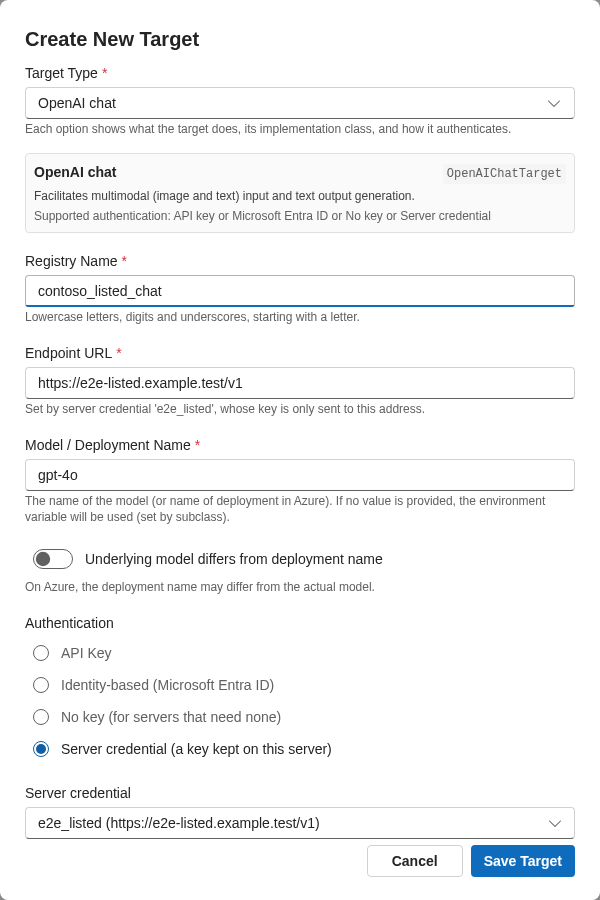
A saved target can't hold a key, so a target that needs an API key could only be Temporary. An administrator can now list keys from the server's environment that users pick by name, each tied to the only endpoint it is sent to.
.pyrit_conftakesserver_credentials: a list of entries with anameusers pick, theenv_varthat holds the key, and theendpointthe key is sent to. Each name can be listed once. The endpoint must be a full http(s) address with no user name, password, query or fragment.GET /api/targets/typeslists each credential's name and endpoint for the types that can use one (the OpenAI targets for now), never the variable or the key.POST /api/targetstakes"server_credential": "<name>"withauth_modeapi_keyand noapi_keyof its own, and not withsource(422 otherwise). The key is used only when the target's endpoint is the credential's endpoint, compared with the scheme and host lowercased and a default port and trailing slash removed. A credential that isn't listed or set, or another endpoint, gets a 400..pyrit_conf_example,doc/getting_started/pyrit_conf.md, the backend README and the GUI doc describe the setting. They say to list a variable that holds only that key: a variable a target reads on its own, such asOPENAI_CHAT_KEY, can still reach any endpoint through a Temporary target created without a key.What stays the same: without
server_credentialsin.pyrit_conf, nothing changes; the types list has empty lists and the dialog offers no new choice. A typed key still makes a Temporary target, and a Temporary target without a key still uses this server's own key variable, as the backend README describes.Screenshots: the New Target dialog with Server credential chosen, and the saved target in the Targets table.

Not covered: