







Tech-art tooling for game-art and DCC pipelines. One toolset that works the same way in Maya and Blender, standalone apps for the work around them, and one public API shared by artists, scripts, tests and AI agents. Two products and the libraries beneath them, built as one architecture that checks its own design.

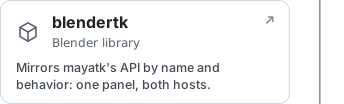

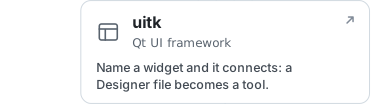
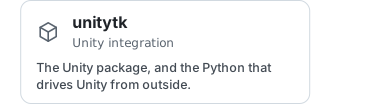



Select a card to open its repo. The map is generated from the packages' own declarations.
Every unit, from the workspace down to a single class, has the same shape: one purpose, a small public surface, a host-free core with a thin adapter for each host, and checks that hold its rules. Everything below follows from that.
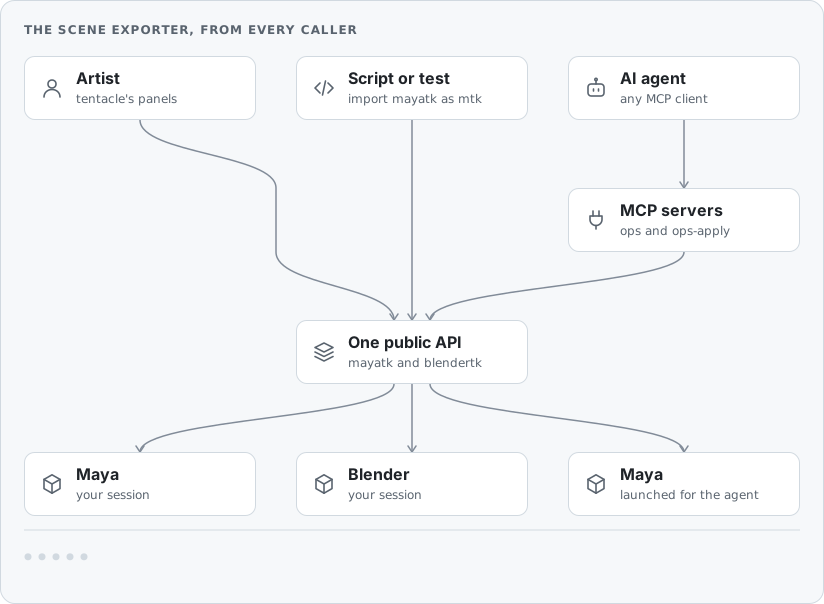
Every operation is a public library function that panels only call, so anything an artist can do, a script, a test or an AI agent can do too.
- The whole API, searchable.
api.searchfinds any public function or class across the packages, C# included, with its signature, its docs and its host. It reads the source and imports nothing. - Built for AI agents. The search, a console in each host and the codebase's own upkeep are served over MCP and the command line. An agent's calls run in a Maya, Blender or Unity instance launched for it, never in a session a person has open.
- Plan, then apply. An operation that changes anything returns its plan from one MCP server and makes the change on a second, so a client can allow every plan and still ask before each change. A result lists what changed, and a problem can name the call that fixes it.
- Yours too.
pip install "pythontk[mcp]" mayatkand twoclaude mcp addlines give your agent the same tools in any project.
- Mirrored by name and behavior. mayatk and blendertk expose the same operations under the same names, so tentacle's menus and all 49 of its tool panels are shared. A control one host can't support is hidden there, never left as a dead button, and CI fails when a shared panel calls anything one library lacks (the scorecard).
- Name it, and it connects. uitk turns a Qt Designer file and a Python class into a working tool: each widget calls the method that shares its name, its state persists and the theme applies, with no glue code.
- Hosts are adapters. Whatever a host does differently sits behind a small adapter with a plain-Python default, so shared logic runs and is tested with no DCC, and tentacle needs one launcher with no per-host fork.
- Declared once, generated everywhere. Scene records are declared in pythontk and read by Maya, Blender, Unity and the WebXR viewer, whose C# and JavaScript types are generated from that declaration and held to it in CI.
- Every port held to its reference. A model that also runs in C# or JavaScript must reproduce cases its Python reference generates at test time, so no port is measured against a stale copy. The height-field shadow shader is one GLSL source for every engine.
- Plug-and-play export. A deliverable is the authored scene written by a stock exporter in an open format, with glTF output tested against the Khronos reference validator. Previews only layer over authored values, and saved fingerprints fail any refactor that changes an export.
- Dependencies point one way. Each package declares the order of its parts, and CI fails any new import, or even a name, that reaches up a layer; older exceptions are frozen and worked down. No library imports a product, and importing a library loads only its declarations, which its tests prove in a fresh interpreter.
- Written once. Logic both hosts share lives in pythontk behind a small adapter each host implements, and CI fails when the same logic is written twice.
- Every check actually runs. A test fails if any check script is wired to nothing: no CI job, release step or scheduled task.
- Workarounds with an expiry. A patch to code we don't own carries a probe that reproduces the bug, so the upstream fix fails a test naming the patch to delete.
- Names that say where they went. A moved name's error gives its new home, even under
from package import name, and a deprecation carries a version and a date that CI enforces. - Tested where it counts. More than 30,000 tests run across the packages, and every bug gets a failing test before its fix. A change runs only the tests it reaches, C# ports included.
- Releases that prove themselves. The release script measures each API change against the published version and refuses a removal shipped as a patch. It publishes only code with a review and a full test run recorded against that exact source tree, and it stops at the source-line ceiling, so growth is a deliberate decision.
The rules, each with its reasoning, are in the code standard; the codebase manifest records the architecture and the decisions that shaped it.
push.ps1releases the chained packages in dependency order. Every phase is idempotent, so running it again finishes whatever an interrupted run left.scripts/holds the checks, generators and parity sweeps.- Agent tooling: rule packs and the workspace's own rules (
agents/), size-budgeted and drift-checked, and a Claude Code plugin (claude/). Setup and use. docs/holds the standards for code, docs, the context budget and test badges.
Conventions and usage: AGENTS.md.
pythontk is MIT; mayatk is MIT with the Commons Clause; uitk, extapps and unitytk are LGPL-3.0-or-later, unitytk's Unity package MIT so it can ship in player builds; blendertk and tentacle are GPL-3.0-or-later, each with an added permission to combine it with mayatk and Maya.