
SwarmBots is a GPU-vectorized multi-agent reinforcement-learning benchmark for simulated self-assembling modular robots. Policies control movement and physical connections: identical robots can move independently, join into load-bearing structures, and separate again during an episode.
The benchmark studies how a team learns to move, assemble, and manipulate objects when its physical connections are part of the control problem. It combines cooperative locomotion, exploration under partial observability, and payload transport in a shared simulation and evaluation interface.
| Wall traversal | Finding a hidden opening |
|---|---|
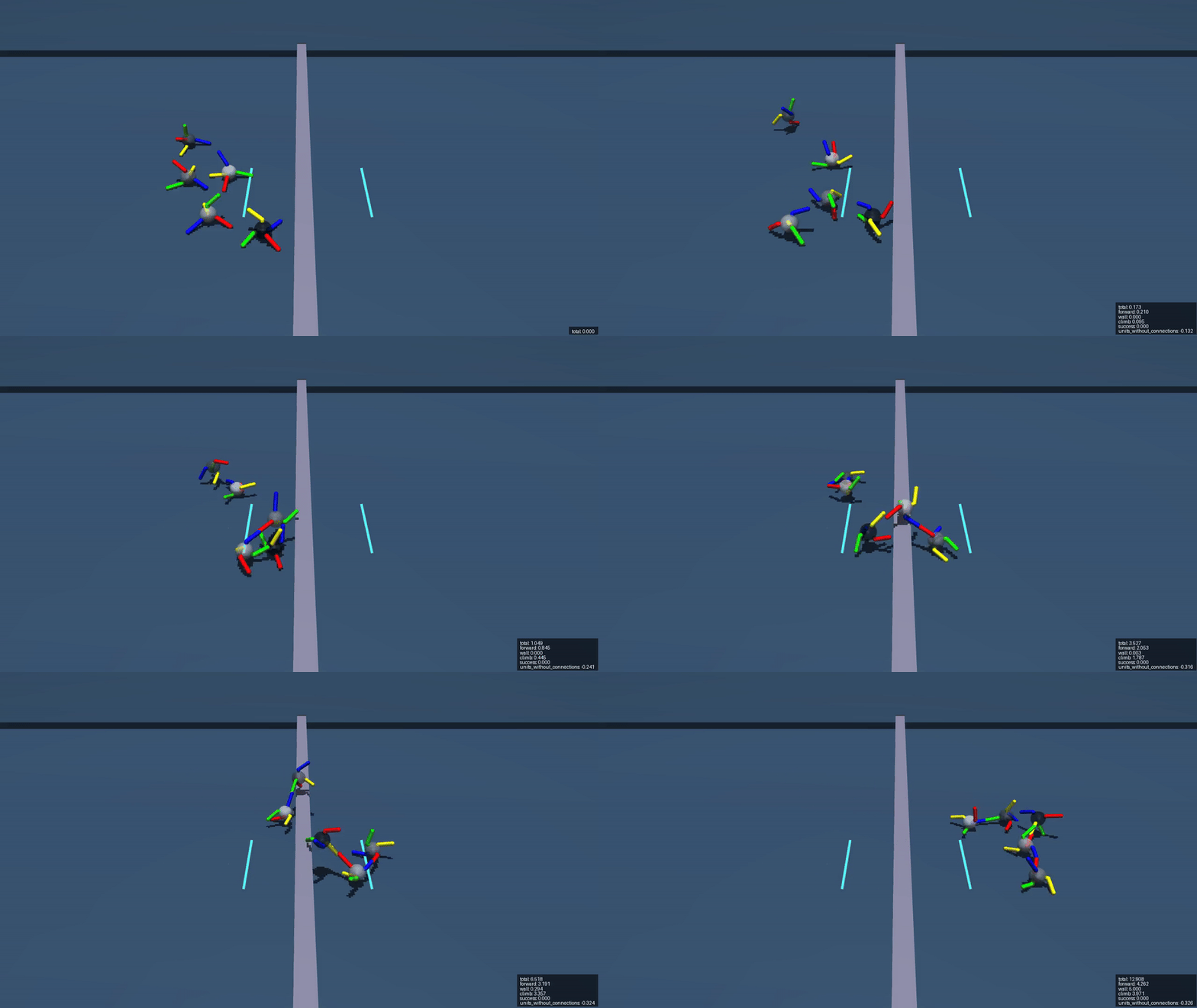 |
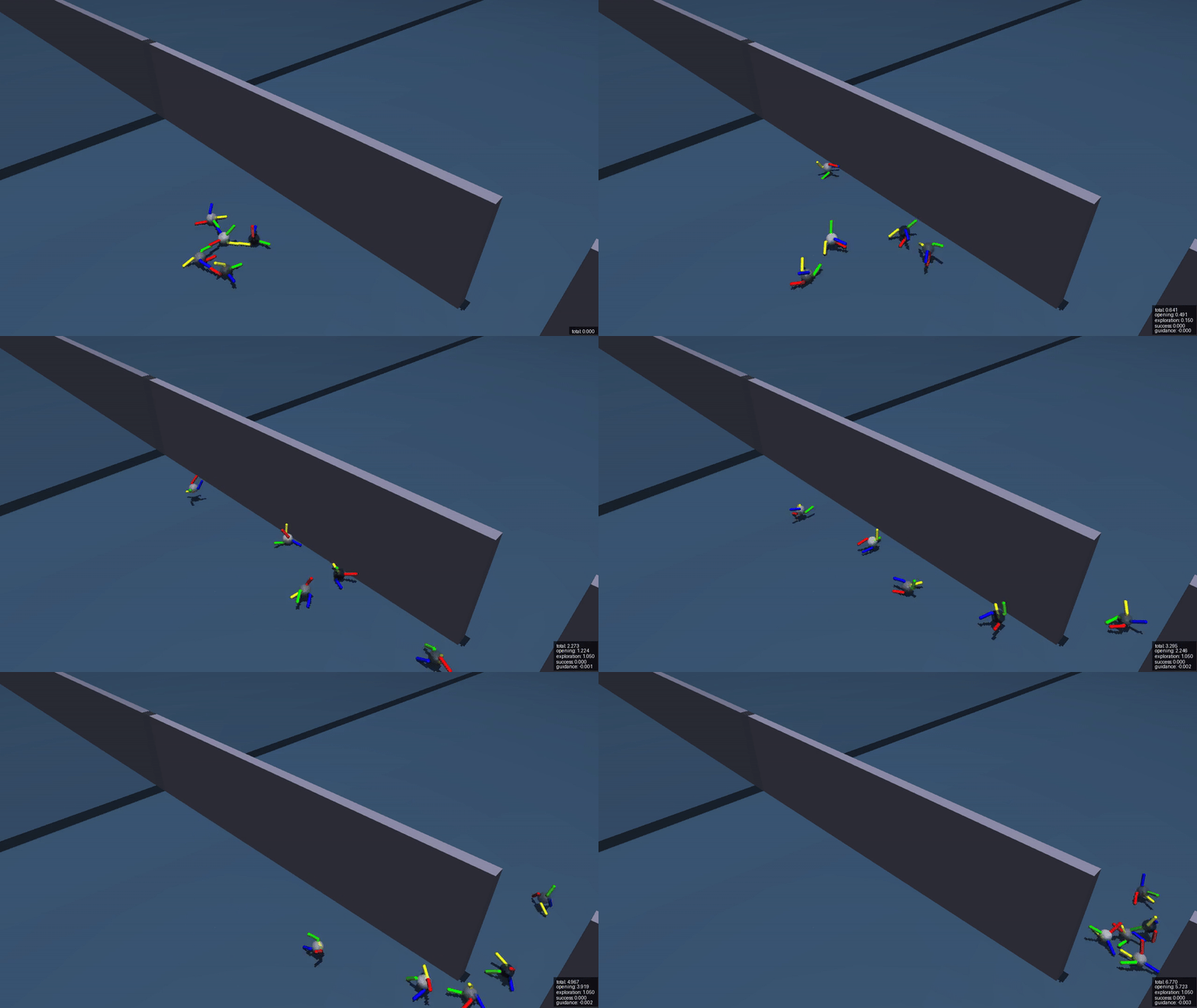 |
SwarmBots is alpha and under active development. Task difficulty, rewards, and success conditions may change. Wall, PO-wall, and FindOpening scenarios are beta after extensive internal testing; other scenarios are alpha. Scenario maturity and versioning explains testing confidence and comparability across versions.
SwarmBots provides tasks for studying coordination through both learned actions and changing physical structures:
| Research direction | Benchmark capabilities |
|---|---|
| Learning physical cooperation | Articulated robots with load-bearing connections that can form and break during an episode |
| Memory and exploration | Hidden walls and openings that require acting with incomplete task information |
| Multi-agent policy design | Public per-agent observations, shared task observations, active-agent masks, and privileged information for training critics |
| Cooperative manipulation | Single- and multiple-payload transport, obstacle traversal, and assigned delivery goals |
| Comparing learning methods | GPU-vectorized MuJoCo Warp environments, a common evaluator, baseline RL algorithms, learning curves, and video recording |
Actors may be centralized or decentralized; their access to other agents' public observations is part of the experimental design. Registered tasks sample four- and five-unit assemblies from a fixed morphology pool. The canonical protocol evaluates that population; separate pools support custom generalization studies.
There are 16 registered tasks, with eight forming the core evaluation suite. Names below expand to SwarmBots-<name>-v0.
| Task family | Names | Challenge |
|---|---|---|
| Wall traversal | WallEasy, WallMedium, WallHard |
Whole-swarm traversal over a fixed wall |
| Partially observed walls | POWallEasy, POWallMedium, POWallHard |
Traversal over a randomized hidden wall |
| Exploration | FindOpening |
Hidden-passage discovery and traversal |
| Bridge traversal | Bridge |
Crossing a narrow movable bridge |
| Climbing and navigation | Climb, VerticalReach, MoveToGoal |
Reaching platform, elevated, or planar goals |
| Payload transport | PayloadPlane, PayloadStep, DualPayloadPlane, PayloadGoal, MultiPayloadGoal |
Cooperative object transport and delivery |
The scenario catalog lists exact IDs, observations, and success criteria. swarmbots describe <benchmark-id> prints a task summary. The benchmark protocol defines the core suite and reporting procedure.
Python 3.11 or newer is required. An NVIDIA GPU with CUDA is strongly recommended for training and evaluation. CPU execution is available for small development runs.
For the runnable examples, install a source checkout with uv:
git clone https://github.com/brn-dev/swarm-bots.git
cd swarm-bots
uv sync --locked
On Windows and Linux, the checkout selects CUDA PyTorch and matching Triton dependencies. CUDA training and evaluation require the driver and compiler configuration described in GPU setup, because environments compile tensor operations by default. Policy compilation is a separate option.
To add the published alpha release to an existing project instead:
uv add "swarmbots==0.1.0a3"The guides here describe the current source checkout. The published 0.1.0a3 release differs in available presets and tools; its versioned documentation describes that release.
On Windows, the PyPI installation selects CPU-only PyTorch by default. Configure the application project's CUDA dependencies using published-package GPU setup. The checkout's CUDA configuration does not carry over to other projects.
From the repository root, list the tasks and check that simulation works:
.venv/bin/swarmbots list
.venv/bin/swarmbots smoke SwarmBots-WallEasy-v0 --device cuda --num-envs 2
On Windows:
.\.venv\Scripts\swarmbots.exe list
.\.venv\Scripts\swarmbots.exe smoke SwarmBots-WallEasy-v0 --device cuda --num-envs 2
A successful smoke test prints a JSON summary after stepping the environment. For a CPU check, use --device cpu. Add --compiled to check compiler setup too; the first compiled run can take longer.
The environments and evaluator work independently of the included learners. Create a vector environment and apply a batch of actions:
import torch
from swarmbots import make_env

env = make_env("SwarmBots-WallEasy-v0", num_envs=2, device="cuda", seed=42)
try:
    observations, info = env.reset(seed=42)
    actions = {
        key: torch.zeros(space.shape, device=env.device)
        for key, space in env.action_space.items()
    }
    observations, rewards, terminations, truncations, info = env.step(actions)
finally:
    env.close()
Observations and actions are batched PyTorch tensors on the simulation device. Policies receive robot observations, public task information, and an active-agent mask. Actors may combine public observations across agents; privileged fields are reserved for training critics and diagnostics.
SwarmBots uses Gymnasium spaces and step conventions, with immediate autoreset when an episode ends. Libraries and wrappers expecting NumPy arrays need an adapter. The Python API guide explains tensor fields and episode handling. The standalone PPO example provides a complete PyTorch training loop independent of the included learning framework.
SwarmBots includes a suite of PPO, MAPPO, MAT, SAC, DDPG, and TD3-based learners, with attention-based and decentralized actors, Deep Set and transformer critics, and recurrent variants. Fixed model-size tiers and optional next-observation prediction (NOP) support architecture and auxiliary-objective comparisons. The learning guide lists presets, training settings, and differences from the original methods; the model reference explains controlled comparison pairs.
The checkout includes a script that trains a baseline, evaluates it, and records videos:
.venv/bin/python examples/train_policy.py SwarmBots-WallEasy-v0 --variant mappo__deepset_critic --run-dir runs/first-mappoOn Windows, replace .venv/bin/python with .\.venv\Scripts\python.exe.
The default run trains on CUDA for ten million environment transitions using 1,024 parallel worlds, evaluates one seed, and records two episodes. The presets are starting configurations, not published reference scores. Training targets high CUDA parallelism; 1,024 worlds are the recommended starting workload. --total-timesteps sets the training budget, --model-scale selects the model size, and --eval-envs controls evaluation parallelism.
This example saves to runs/first-mappo/, which must not already exist. Without --run-dir, each invocation creates a separate directory under runs/. Outputs include:
| Output | What it is for |
|---|---|
log.csv or its compressed counterpart |
Training progress and metrics |
run_metadata_*.json |
Configuration and runtime information |
models/*.pt |
Saved checkpoints for continuation or recording |
evaluation.json |
Evaluation episodes and summary scores |
videos/*.mp4 |
Qualitative inspection of the trained policy |
The runnable examples cover other presets and command options. The learning guide also covers Python training and checkpoint continuation, while log plotting covers learning curves.
The evaluator accepts a callable policy(observations, episode_starts) returning actuators and connectors tensors. Given a trained callable policy, evaluate one task and seed:
from swarmbots import evaluate_policy

result = evaluate_policy(
    policy,
    "SwarmBots-WallEasy-v0",
    num_envs=256,
    num_episodes=256,
    seed=1000,
    device="cuda",
    action_mode="deterministic",
)
print(result.mean_return, result.success_rate)
Configure evaluation mode, deterministic actions, and frozen normalization before evaluation; action_mode only records that configuration. For included baselines, from swarmbots.learn import as_benchmark_policy provides an adapter: policy = as_benchmark_policy(trainer, deterministic=True), where trainer comes from Python training or checkpoint continuation. Create a fresh adapter for each evaluation.
Protocol 0.1 defines comparable scores using unmodified tasks, seeds 1000–1004, and 256 first episodes per seed, for 1,280 episodes per task. Reports contain per-task return and success where defined, mean and standard deviation across seed-level results, and the package version, Git commit, checkpoint, and training budget. Evaluation samples the registered morphology pool; it does not test unseen morphologies.
swarmbots record <benchmark-id> --checkpoint <path> --variant <variant> records a saved checkpoint. The recording guide covers complete commands and video options.
The documentation guide links setup, training, custom-policy integration, evaluation, recording, and plotting workflows. The online diagram viewer shows model architectures without a local installation. Command-line tools also inspect policy sizes and generate architecture diagrams.
GitHub issues and email to Dominik Baron at dominik.b4ron@gmail.com are the channels for bug reports and task-design feedback. Reports are most useful with the task ID, version or commit, command, seed, and observed behavior.
Software citation metadata for the version used in an experiment is available in CITATION.cff.
The benchmark and policy designs are described in Dominik Baron (2026), SwarmBots: a GPU-accelerated multi-agent continuous control benchmark with transformer baselines, master's thesis, Johannes Kepler University Linz (published thesis, source and supplementary material).
The included learners adapt the original algorithms to a shared team objective. The method differences affect comparisons with original implementations. References and attribution maps learners to their papers and credits the scientific software. Reusable entries are available in references.bib.
SwarmBots is released under the Apache License 2.0.