
Exact lookups over a Robot Framework test repo, for people and scripts. Ask
which tests cover a ticket, who calls a keyword or where an endpoint is used,
and get one line per hit with its file:line instead of reading whole suites.
It indexes:
- tests: name, tags (
bug:PROJ-123,role:...,op:GET /api/...), first doc line, keyword calls - user keywords: name, arguments, first doc line, calls, variables used
- variables from
*** Variables ***and inlineVARstatements, with their values - suite and test setup/teardown calls
- JSON files under
docs/, one entry per object key
From PyPI, in the test repo's venv:
pip install robotframework-mind        # the CLI: python -m robot_mind
pip install robotframework-mind[gui] # also the desktop app: python -m robot_mind_appPython 3.10+ and robotframework (the repo's own venv already has it). No
other packages for the CLI.
From the test repo's venv (python -m robot_mind in place of
python path/to/robot_mind.py once it is installed):
python path/to/robot_mind.py --root <repo> ticket PROJ-123
python path/to/robot_mind.py --root <repo> kw "Open Profile Browser"
python path/to/robot_mind.py --root <repo> callers "Open Profile Browser"
python path/to/robot_mind.py --root <repo> tag role:role_quality_control
python path/to/robot_mind.py --root <repo> find /api/items/query| Command | Returns |
|---|---|
ticket KEY |
tests and keywords whose tags, name or doc mention the key |
kw NAME |
every definition, matched the way Robot matches names (case, spaces and underscores ignored) |
callers NAME |
each call site: keyword, test or suite fixture, at the call line; falls back to substring when no exact name matches |
tag TAG |
tests with that tag; role:* matches a prefix |
find TEXT |
names, tags, docs, args, values and JSON entries containing the text, then the keywords that use a matching variable |
--limit N caps the lines (default 20). No hit prints no match. --json
prints the hits as a JSON array (each with kind, name, file, line; a
callers hit also carries call_line).
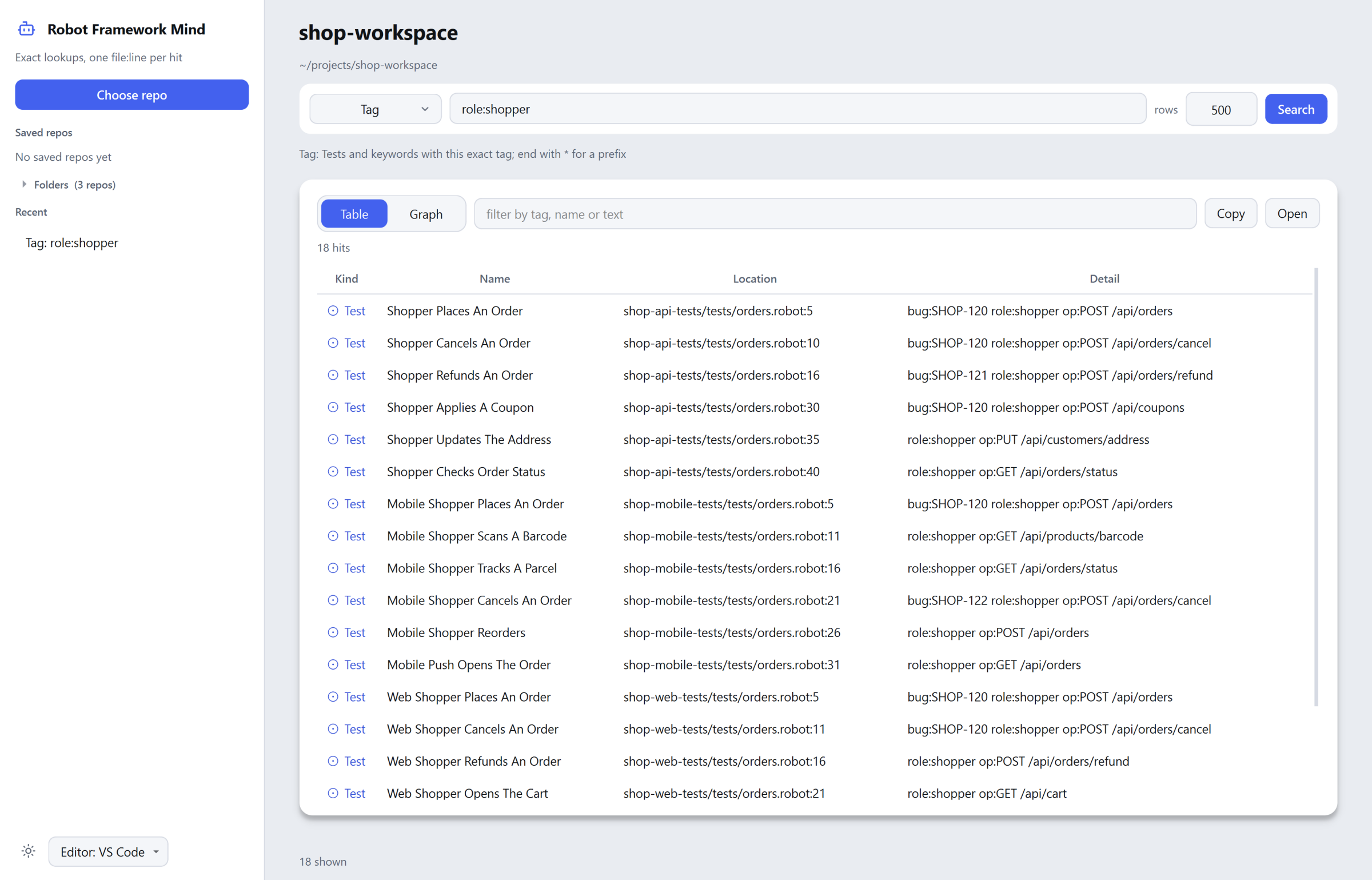
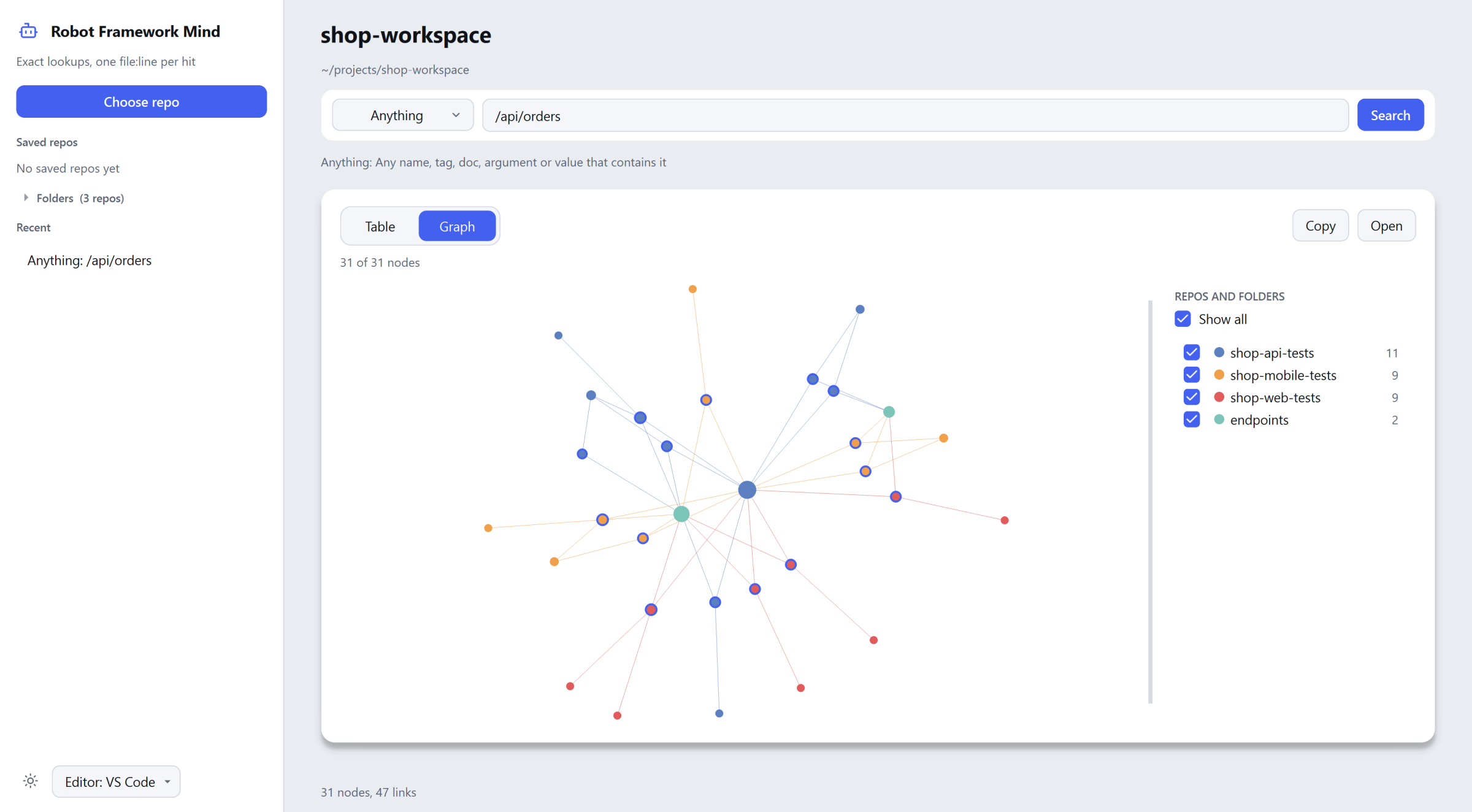
The same lookups in a window. Pick a repo (or a folder that holds several), choose what to search for, and get the hits as a table or as a graph of what they call, use and hit. Open takes you to the file at the line in your editor.
Install it from PyPI (see Install above), download a build from the releases page, or run it from source:
pip install -e .[gui]
python -m robot_mind_appFive questions on a real API test repo (553 Robot and JSON files, 9,930
indexed entries), answered three ways: this tool, a plain grep -rn over the
same files, and graphify 0.9.102 (graphify update, then graphify query
with the question in words). Sizes are characters of output; "files" is how
many of the files that hold the answer the output names.
| Question | robotframework-mind | grep | grep, then open the matched files | graphify query |
|---|---|---|---|---|
| tests for a ticket (7 hits in 2 files) | 1,570 chars, 2 of 2 files | 2,181, 2 of 2 | 18,611 | 17,328, 0 of 2 |
| where a keyword is defined (1) | 167, 1 of 1 | 3,290, 1 of 1 | 346,452 | 6,804, 1 of 1 |
| who calls that keyword (30 calls in 10 files) | 3,411, 10 of 10 | 3,290, 10 of 10 | 346,452 | 6,802, 3 of 10 |
| tests with a tag (60 in 27 files) | 41,107, 27 of 27 | 38,363, 27 of 27 | 136,226 | 6,704, 0 of 27 |
| where an endpoint is used (8 in 6 files) | 2,879, 6 of 6 | 1,935, 6 of 6 | 2,642,809 | 6,838, 0 of 6 |
grep finds the same files and its matched lines are about as short, but a
matched line is the tag or the call, not the test or keyword around it, so
the next step is opening the files: that is the third column. graphify's
explain does better on keywords (all 10 caller files in 3,564 characters)
but found nothing for the ticket, the tag or the endpoint.
Building the index took 2.3 s the first time and 0.25 s after that; the graphify build of the same repo took 44.9 s.
The index lives in ~/.cache/robotframework-mind/, one file per repo, never
in the repo. Each call compares file times and sizes and parses only changed
files. It reads each .gitignore on the way down (and .git/info/exclude)
itself, without calling git, so ignored probes and results stay out; a nested
repo follows only its own rules. Hidden folders, node_modules, results and
virtualenvs are skipped too. A file git tracks but a rule ignores is left out
as well. Files over the size cap are skipped: 5 MB for docs/ JSON, 50 MB for
.robot and .resource.
python -m unittest tests.test_whereMIT, see LICENSE.
The parsing approach follows the Robot Framework extractor in
graphify by Safi Shamsi
(Apache-2.0): Robot's own robot.api parser with a ModelVisitor, and
keyword names normalized the way Robot resolves them. No graphify code is
copied. See NOTICE.