
Public infrastructure for the Edge Economy. Human authority first.
TitleChain Foundation stewards open standards, open-source infrastructure, and public research designed to move identity, assets, intelligence, and economic agency back to the edge — to people, businesses, communities, and sovereign institutions and nations.
We are building the public commons for a human + AI economy where agreements, rights, and digital assets can move with verifiable trust; decisions are auditable; agents remain accountable to humans; and no single company controls the trust layer.
| I am a... | Go here |
|---|---|
| Investor / funder | Featured projects · Sponsor the Foundation |
| Policy / legal reviewer | Legislative review · SEC Public Input Summary |
| Builder / contributor | Skills we need · Explore ICSN Standards |
| Prospective member | Set up your free IAM account · Reserve your M5POD |
| Press | Press and media |
Every task from the original page is still here — see the full task index at the bottom if you want everything in one table.
TitleChain Foundation has published model legislation proposing private and local access to open-weight AI, human authority over agent actions, state-primary administration, vendor neutrality, public disclosures, and anti-capture safeguards.
Status and Public-Interest Work
This proposal is not enacted law, has not been introduced by a legislative office, and is not yet an adopted ICSN standard. It is published for research, education, public review, and further legislative and standards development.
It is part of a broader body of work developed, presented, and advanced since 2017 across legislation, regulatory testimony, open standards, public education, and technical infrastructure for the emerging human + AI and digital-asset economy.
That work includes initiatives and proposals addressing the Bill of AI-Chip Rights, BRIDGE — Blockchain Registry Inter-bank Digital Asset Exchange, Swift-BRIDGE, the Sovereign Compute Access Act, Digital Asset Property Title Rights, 23andMine, and related frameworks for sovereign identity, digital property, compute access, machine authority, financial infrastructure, and human rights in an AI-native economy.
The purpose of publishing this work in the public commons is to make the underlying research, architecture, draft language, testimony, and technical standards available for independent review, improvement, implementation, and consideration by lawmakers, regulators, researchers, technologists, and the public.
These are not claims of enacted law. They are part of an ongoing public body of work designed to help develop the legal and technical infrastructure for the next generation of the digital economy.
Read the full legislation · View the Act carousel · View the Open Weights + M5 carousel · Open the public-review hub · Submit a public comment · Explore ICSN
Comments, legal analysis, technical review, accessibility feedback, proposed amendments, and legislative-office inquiries are welcome. Nonpublic inquiries may be sent to support@titlechainfoundation.org.
CLICK TO View supporting appendix diagrams (Sovereign Intelligence Stack, Open-Weight Compute Reference)
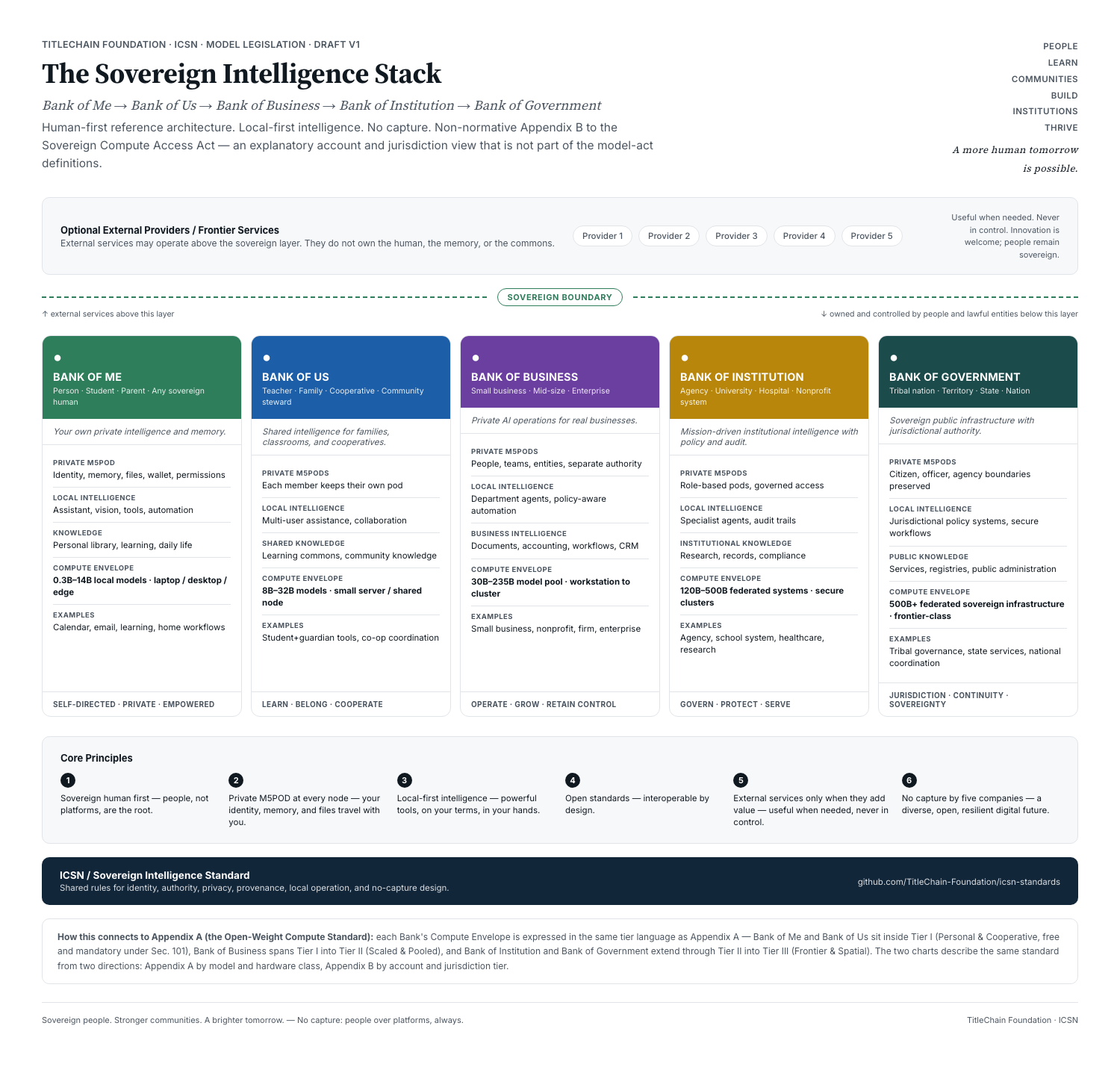
A human-first reference architecture for locally controlled intelligence, memory, authority, and optional external providers across personal, community, business, institutional, and government contexts. This is non-normative Appendix B to the model act.
Open the interactive appendix · Comment on the architecture
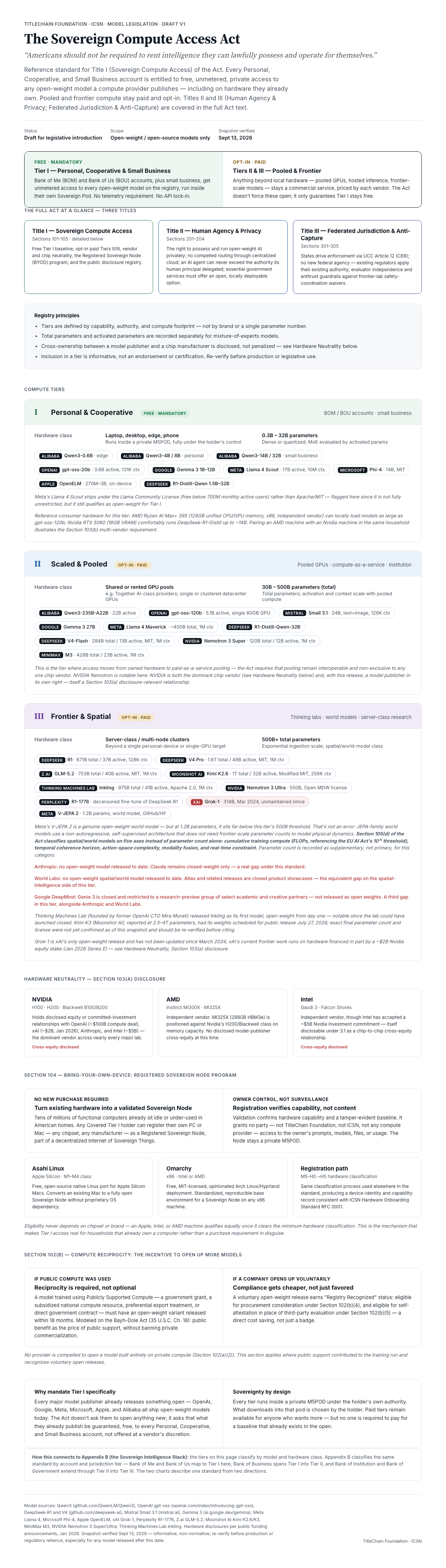
A proposed, non-normative reference for discussing personal, pooled, and frontier compute; open-weight model access; hardware capability; registered sovereign nodes; and reciprocity for publicly supported training. The classifications are open questions for legal, technical, economic, security, accessibility, and implementation review.
Open the full reference · Review the current seed questions · Submit evidence or corrections
We invite companies, providers, researchers, educators, workforce organizations, and people across technology, law, economics, statistics, finance, identity, privacy, security, accessibility, and community governance to help shape a public commons for the digital-asset edge economy. Participants can propose one bounded product, interface, dataset, methodology, skill, role-transition need, or training pathway across the stack.
Set up your IAM account · Reserve your M5POD · Choose a commons contribution track · Review native M5Agents · Introduce a proposal · Open the SEC current status summary
The M5 architecture makes AI operationally useful without allowing AI, credentials, wallets, employees, contractors, APIs, or third-party systems to become unaccountable sources of authority.
The visuals are Illustrative Public Review Drafts. They are not adopted standards, official statistics, regulated benchmarks, production deployments, credentials, certifications, or representations of government endorsement. Maintained repository text and governance records control where visual shorthand differs.
View architecture diagrams (M5POD stack, wallet controls, economic layers)
M5POD private member stack

| Human-authorized wallet and agent controls | Economic and rights layers |
|---|---|
 |
 |
Three public development simulations connect the Commons standards to assets, authority, financing boundaries, and accountable records. These are research and diligence projects, not offerings, approved transactions, or grants of authority.

A public real-estate and historic-reuse simulation centered on 312 N. Spring Street, Los Angeles. It connects GSA disposition diligence, title and public-owner authority, capital provenance, rehabilitation, and public-benefit operations. The updated work includes The Bear Comes Home and the Public Bank of California concept, with bank/escrow and securities records kept separate.
Concept and diligence only: no property award, bank charter, California-agency status, deposit-taking, committed financing, or regulated-intermediary status.
Explore Spring Commons · Read The Bear Comes Home · Review GSA diligence · Initial capital tranche brief

A repeatable stewardship simulation connecting farmland, food production, local operators, title and economic-right separation, correction, and portable evidence. Pilot 001 tests the sample-data process; later pilots are intended to test independent replication and scale without concentrating ownership or authority.
The 275,000-acre figure is a research-pipeline target, not acreage owned, controlled, under contract, or offered by the Foundation or People's Trust.
Explore the Farmland simulation · Capital & Operating Partner Brief
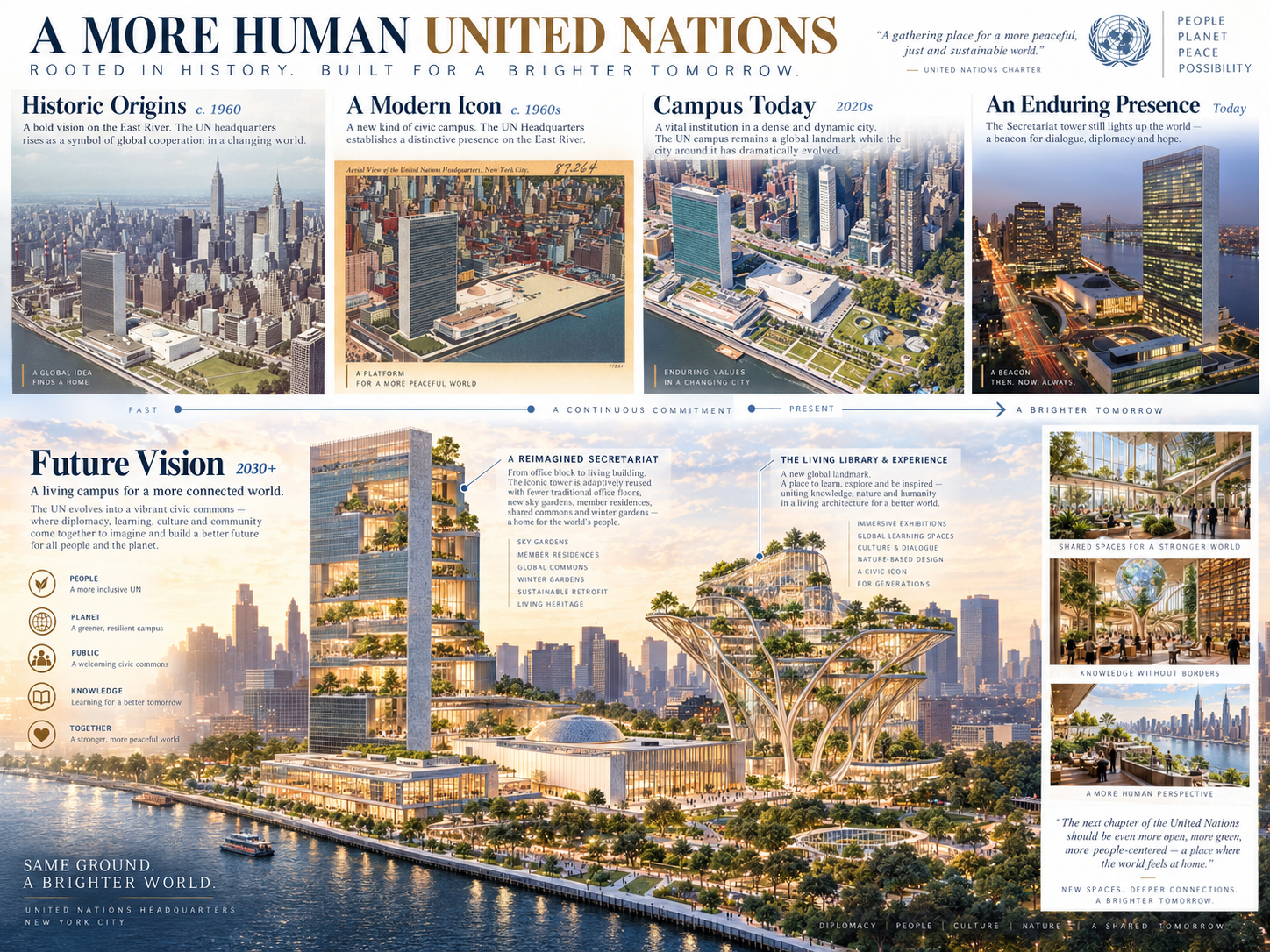
Global UN Commons — concept and design by TitleChain Foundation (2026).
An international development concept exploring public-record and transfer-agent interoperability across a proposed 193-Member-State jurisdiction-profile inventory. The V1–V4 visual library preserves the project's progression and supporting research.
Independent concept: no United Nations or Member State endorsement, government participation, nation-chain activation, or institutional authority is implied. Each jurisdiction requires its own lawful mandate and accountable operators.
Explore Global UN Commons · View the V1–V4 visual library · Founding Institutional Underwriter Brief
SEC public input is a cross-cutting research and public-review layer across the three development lanes. Repository reviews and GitHub comments are not SEC submissions, adopted rules, or SEC endorsement. The Foundation's September 5 filing remains distinct from its September 24 implementation review.
Explore the M5 AI Sovereign Commons · SEC Public Input Summary · Pilot/SEC Crosswalk v0.2 · September 24 Open Commons Review · Live SEC Public Comment Observatory
We welcome focused help from engineers, architects, security and privacy reviewers, identity and authorization specialists, legal and governance reviewers, researchers, educators, accessibility testers, technical writers, and community builders.
Choose a contribution by skill. You can review one flow, test one claim, improve one document, or recommend one concrete change.
The organization currently has three GitHub members. Public participation does not require organization membership, IAM, an M5 account, or a funded role. We are building a public contribution record while raising funds for defined work.
One public pathway: Discussion -> scoped Issue -> contribution -> independent review -> evidence -> release.
TitleChain Foundation governs the public standards process. ICSN contains public RFCs, schemas, governance, and conformance work. M5 is one implementation and activation environment; it does not own the standard.
Never post credentials, private participant data, wallet information, confidential business material, production secrets, or unreported vulnerabilities in public Discussions or Issues.
Publication, participation, waitlist enrollment, or sponsorship does not create a credential, account, job, investment, governance authority, legal representation, or standards approval. Funding does not purchase standards control or access to private data.
- Human authority remains the root of consequential digital authority.
- Privacy, meaningful consent, portability, recovery, and the right to exit are structural requirements.
- Standards remain open to public review and independent implementation.
- The goal to support up to 100,000 women-led ventures is an activation goal, not a claim of completed enrollment or funding.
Governance | Security | Code of Conduct | Trust and Non-Capture
Follow. Review. Build. Sponsor. Bring one more capable person into the work.
- TitleChain Foundation Opens Public Commons Reference Project for Real-World Asset Transfer
- TitleChain Foundation Publishes Model Legislation Guaranteeing Free Public Access to Open-Weight AI
- TitleChain Foundation Issues Global Call to Build Public-Commons for Human-Controlled AI
- TitleChain Foundation Opens Sovereign AI & Digital Asset Commons, Invites Builders
For current Foundation information, visit TitleChainFoundation.org. For M5 product, technology, architecture, research, and public media, visit M5Bank.app. Media and partnership inquiries may be directed to hello@titlechainfoundation.org.
Full task index
| I want to | Go here |
|---|---|
| Review the Sovereign Compute Access Act Draft v1 | Read the draft and comment publicly |
| Ask, introduce myself, share an idea, or offer a skill | Use Contributor Q&A |
| Show how a company, product, dataset, or methodology can support the stack | Use the commons contribution tracks |
| Find where my expertise, product, or learning goal fits | Explore all 37 SOPHIA tracks |
| Share expertise, role changes, or training needs without posting a private CV | Use the public-safe workforce pathway |
| Introduce a provider, economic-data, workforce, or training proposal | Join Discussion 22 |
| Review native M5Agents, authority controls, graphs, threats, and verification | Start with the M5-agent discussion series |
| Follow the broader commons project board | Coming soon: intake is open now in Discussion 22 |
| Review the demo or explore an activation program | Visit Programs & Activation |
| Review the SEC filing's public reference artifacts | Open the Appendix B artifact directory |
| Check the current SEC docket and review status | Open the SEC Public Input Summary |
| Review the People's Trust project simulation and repeatable pipeline | Open the visual simulation library |
| See deadline and completion progress | Open the SEC public-review milestone |
| Establish the free IAM starting point | Set up your IAM account |
| Join the M5POD activation waitlist | Reserve your M5POD |
| Review standards or claim scoped work | Explore ICSN Standards |
| Fund public work and contributor capacity | Sponsor the Foundation |
| Discuss an organizational partnership | Contact the Foundation |