


MicroPython library for the Protocentral easyECG Breakout: single-lead (Lead I) ECG over I²C / Qwiic. It handles the sampling, filtering and heart-rate detection. The same driver also runs on a Raspberry Pi.
Don't have one? Buy it here
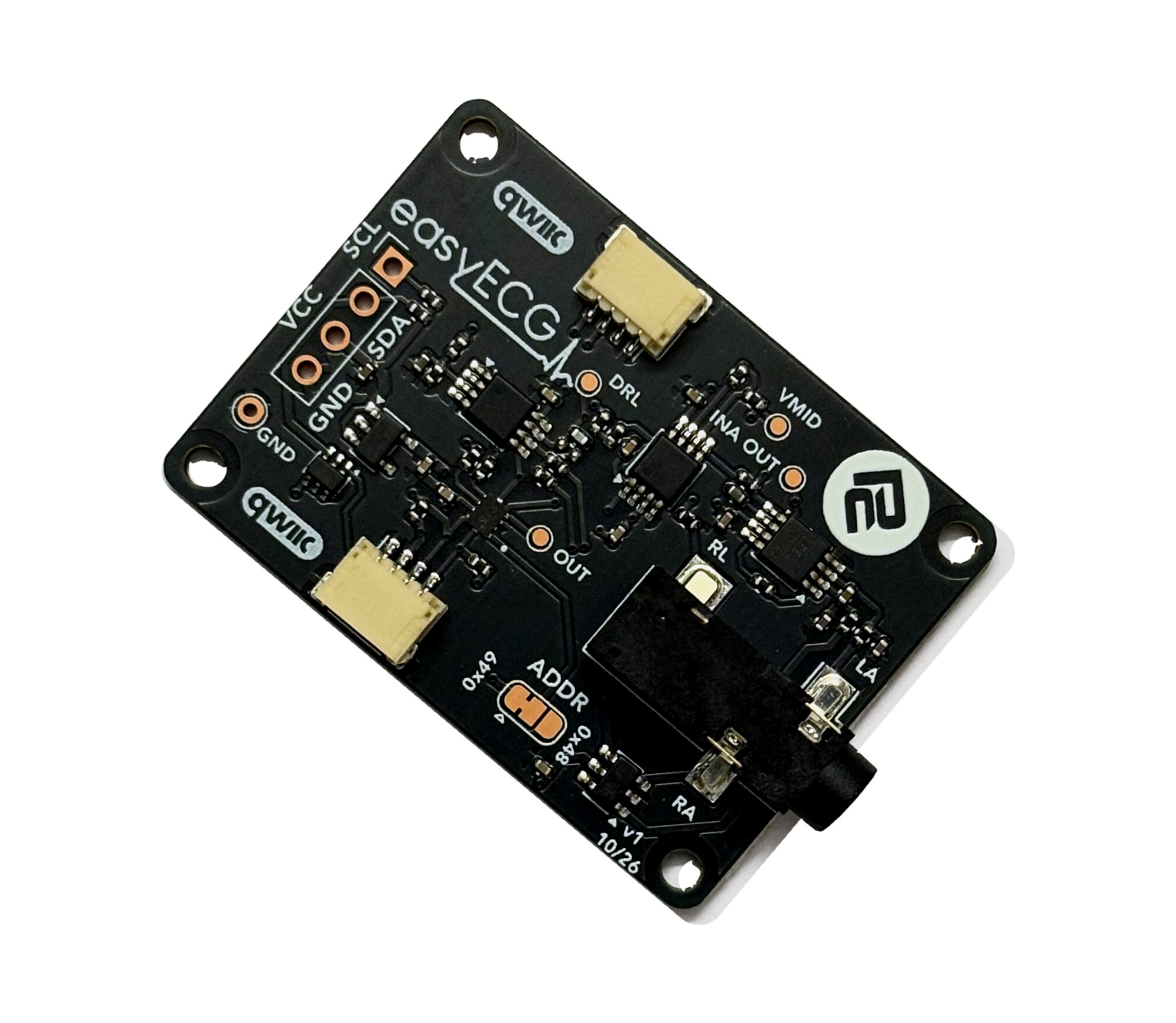
Wiring, electrode placement and troubleshooting are in the easyECG Getting Started guide.
| Product page | https://protocentral.com/product/easyecg-single-lead-ecg-breakout-qwiic/ |
| Getting Started guide | https://protocentral.com/product/easyecg-single-lead-ecg-breakout-qwiic/docs/getting-started/ |
| Arduino library | https://github.com/Protocentral/protocentral_easyecg_arduino |
| Hardware design files | https://github.com/Protocentral/protocentral_easyecg_hardware |
- Paced sampling with missed-sample counting: 250 SPS in, 125 or 250 Hz out
- 50/60 Hz notch and 40 Hz low-pass in software; no high-pass by default, to keep the ST segment
- Heart rate from a simplified Pan-Tompkins R-peak detector
- Saturation, mains-pickup and a provisional lead-off flag
- Readings in µV at the electrodes
- A port of the Arduino library 1.0.0: the same API in snake_case, and a Python version of every Arduino example
Not a medical device. For research and education only. The breakout has no patient isolation: when electrodes are on a person, power the host from a battery or connect through an easyISO isolated Qwiic adapter. On a mains-powered host you get a flat line, and
is_saturated()reports it.
MicroPython (Raspberry Pi Pico, ESP32, …):
mpremote mip install github:Protocentral/protocentral-micropython-easyecgThis also installs the TLA20xx driver. With Thonny, copy protocentral_easyecg.py and protocentral_tla20xx.py to the board instead.
Raspberry Pi, with I²C enabled (sudo raspi-config nonint do_i2c 0):
python3 -m venv ~/easyecg && source ~/easyecg/bin/activate
pip install protocentral-easyecgfrom machine import Pin, I2C
from protocentral_easyecg import EasyECG
i2c = I2C(0, scl=Pin(5), sda=Pin(4), freq=400000) # Pico: GP5, GP4. Change for your board
ecg = EasyECG(i2c) # default address 0x49
if not ecg.begin():
raise OSError("easyECG not found")
while True:
if ecg.update(): # True at the output rate, 125 Hz
print(ecg.ecg_microvolts(), ecg.heart_rate())On a Raspberry Pi, replace the I²C lines with from protocentral_tla20xx_linux import I2C and EasyECG(I2C(bus=1)).
Call update() as often as you can; it samples only when the clock is due, and never blocks. If missed_samples() grows, your loop is too slow.
| Method | Description |
|---|---|
EasyECG(i2c, address=0x49) / begin() |
Construct / configure the ADC. begin() returns False if the board doesn't answer |
update() |
Non-blocking. True when a new output sample is ready |
ecg_microvolts() / ecg_filtered() |
Filtered output, in µV at the electrodes / in counts |
ecg_unfiltered_microvolts() / ecg_unfiltered() |
Plain ADC average |
heart_rate() / beat_detected() / last_rr_millis() |
bpm, 0 until established / true once per beat / last R-R interval |
is_saturated() / is_lead_off() / mains_microvolts() |
Signal-quality flags; lead-off is a provisional heuristic |
set_sampling(adc, out) / missed_samples() |
Sample clock (default 250, 125) / samples the loop couldn't take on time |
set_notch(hz) / set_low_pass(hz) / set_high_pass(hz) |
Filters: 50 Hz, 40 Hz, off by default. 0 disables |
calibrate_baseline(ms) / set_baseline(n) |
Measure and subtract the resting offset |
The full API, including the low-level ADC passthroughs, is documented in protocentral_easyecg.py.
| # | Example | Description |
|---|---|---|
| 01 | easyecg_simpletest.py / easyecg_raspberrypi.py |
Filtered ECG in counts and µV (MicroPython / Raspberry Pi) |
| 02 | easyecg_plotter.py |
Filtered and unfiltered traces for Thonny's plotter |
| 03 | easyecg_heartrate.py |
Heart rate on every beat, with saturation and lead-off messages |
| 04 | easyecg_openview.py |
Stream to OpenView 3.4+ (easyECG Breakout). Save it to the board as main.py, then close Thonny or mpremote before connecting OpenView |
| 05 | easyecg_diagnostics.py |
I²C, ADC, noise, mains and sample-rate checks. Run this first if something is wrong |
The examples default to QT Py ESP32-C3 pins: change the I2C(...) line for your board.
- Software: MIT, see LICENSE.md
- Hardware: CERN-OHL-P v2, in the hardware repo
Copyright (c) 2026 Protocentral Electronics.
Open an issue on GitHub or email support@protocentral.com.