

The training side of PlugRL: it holds the policy and the learning algorithm, batches inference across every connected env client over WebSocket, and learns from the feedback those clients send back.
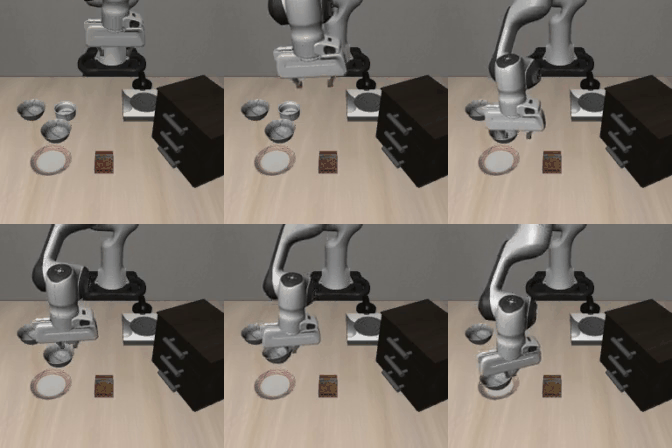
The unmodified pi0.5, driven through this server on libero_spatial task
0 - one episode of the three that ran, all three successful. These are the
frames the env client sends as observations, at the policy's native 224x224,
not an outside camera. The fine-tuned policy is the one that scores zero,
below.
A full-size pi0.5 has run end to end through it on LIBERO - inference,
feedback and FPO training - with the server's record of episodes and steps
reconciling exactly with the clients'. As a control, the unmodified checkpoint
scored 99 of 100 on libero_spatial and 185 of 200 on libero_10, against
openpi's published 98.8 and 92.4.
The reinforcement learning result is negative. One FPO iteration took the hardest task from 26 of 50 to 0 of 50, and the run is incomplete at one iteration of ten: a second learn step does not fit beside the optimizer state the first one allocates on a 24 GB card. The predictions were registered before the run, and one of them is falsified.
| Question | Answer | |
|---|---|---|
| E1 | Do a training stack and an environment stack really conflict? | No - the assumption this project was built on is disproved |
| E6 | Does anything here actually learn? | Yes - FPO on HalfCheetah-v5, three seeds |
| E7 | What does the boundary cost once packets leave the machine? | +0.52 ms on a 184 KiB observation |
| E10 | Is that cheap beside a VLA forward pass? | Yes - 1.3-3.6% of a step |
| E11 | Can a real VLA be trained through this boundary, and does it help? | Ran end to end; did not help |
experiments/ holds twelve of these, eleven of them run. Each
carries its data and a FINDINGS.md stating what the result does not
support. The documentation, including a quickstart that trains FPO on
HalfCheetah with no GPU and nothing to download, is at
plugrl.github.io.
Install the package with pip:
pip install -e .We use uv to manage dependencies and development environments.
-
Install uv (if not already installed):
curl -LsSf https://astral.sh/uv/install.sh | shOr use your package manager (e.g.,
brew install uvon macOS). -
Clone the repository:
git clone https://github.com/PlugRL/plugrl-server.git
cd plugrl-server
Nothing in the default install needs a git submodule.
pi0-policydoes - see Training PI0 (OpenPI) with FPO for the extra steps a plain clone does not give you. -
Install dependencies with uv:
uv sync
This creates a virtual environment at
.venv/and installs everythingpyproject.tomlasks for. -
Run commands via uv:
uv run python -m plugrl_server.cli --help
plugrl-server provides command-line utilities to run RL training with different algorithms and policies. The codebase supports both local training with WebSocket-based agent communication and distributed training with Ray.
Algorithms:
fpo- Flow Policy Optimization. The one that learns with no extras installed.dummy- Dummy algorithm for testing and debugging. Itslearnis asleep; it moves no weights.dppo- DPPO (Diffusion Policy Policy Optimization). Requiresplugrl-server[dppo].dppo-dist- Distributed DPPO (experimental)eval- Evaluation only, no learning
Policies:
fpo-policy- Flow policy. Defaults toobs_dim=17,action_dim=6dummy-policy- Outputs random actions (for testing)dppo-policy- DPPO policy (requiresplugrl-server[dppo]and a checkpoint)pi0-policy- PI0 policy (OpenPI). Needs more than a checkpoint. Theopenpipackage is not on PyPI and no extra installs it: it is thethird_party/openpigit submodule, whichgit clonedoes not fetch. See Training PI0 (OpenPI) with FPO.
python -m plugrl_server.cli --help lists the policies that are actually
available in your install - with no extras it prints {dummy-policy,fpo-policy},
and dppo-policy and pi0-policy are simply absent.
Algorithms do not behave the same way, and dppo is the trap. With no
dppo package installed, ... fpo-policy default --help still offers
{fpo,dummy,eval,dppo}: the DPPO config module imports cleanly and
registers its configs, while the module carrying the algorithm class does not.
Selecting dppo parses, starts up, prints the config, and then dies with
KeyError: 'Algorithm dppo is not registered.'. The real signal is the
warning on the very first line of every command,
Could not import DPPO algorithm module for reason: No module named 'dppo'.
(dppo-dist is genuinely absent in that state, so the menu is inconsistent
with itself.)
FPO on HalfCheetah-v5, CPU only, no extras beyond plugrl-env-client[mujoco].
HalfCheetah-v5 has a 17-dimensional observation and a 6-dimensional action,
which are exactly fpo-policy's defaults, so nothing needs configuring.
# Terminal 1: the training server
python -m plugrl_server.cli fpo-policy default fpo default \
    --port 8000 --policy.device cpu \
    --algo.global-steps 500000 --algo.buffer-size 4096

# Terminal 2: the environment (from plugrl-env-client)
python -m plugrl_env_client.cli mujoco-v1 \
    --server-port 8000 --num-envs 1 --num-episodes 600 \
    --runner.replan-steps 1 --runner.seed 0
Episode return starts near -300. Across three seeds it is still dipping back
into the -300s at step 20k, the mean crosses zero at about 60k, and by 500k
steps it reaches 1928 +/- 224 - roughly a hundred minutes on the CPU-only
laptop that measured it. The first few minutes are noise; judge it over tens
of thousands of steps. experiments/e6-first-learning-curve/ has the
three-seed curve, the logs and the findings.
--algo.buffer-size is not optional here, and the default will surprise
you. FPO learns when its rollout buffer fills or when the run reaches its
last step. At the default buffer_size=983040, any run shorter than about a
million steps therefore learns exactly once, at the very end - producing a
single point rather than a curve. 4096 gives one update per 4096 environment
steps.
To test the agent-server connection with dummy algorithm and policy:
# Terminal 1: Start the server
python -m plugrl_server.cli dummy-policy default dummy default

# Terminal 2: Start the environment client (from plugrl-env-client)
# The server will listen on localhost:8000 by default
Expected output from server:
12:34:56|INFO|plugrl_server version: 0.1.0
12:34:56|INFO|Algorithm: dummy, Config: DummyAlgoConfig(...)
12:34:56|INFO|Policy: dummy-policy, Config: DummyPolicyConfig(...)
12:34:56|INFO|Checkpoint Manager created:
<...CheckpointManager object...> at ./checkpoints/dummy/dummy-policy/...
12:34:57|INFO|Policy created...
12:34:57|INFO|Algorithm created:
<...DummyAlgorithm object...>
12:34:57|INFO|Agent Server is listening on 0.0.0.0:8000
# Single GPU training with WebSocket server
python -m plugrl_server.cli dppo-policy default dppo hopper \
  --exp_name my_dppo_exp \
  --track.enabled

# With custom learning rates and batch size
python -m plugrl_server.cli dppo-policy default dppo hopper \
  --algo.actor_lr 5e-5 \
  --algo.batch_size 256 \
  --exp_name my_dppo_exp_custom
Configuration options:
--algo.actor_lr- Actor learning rate (default varies by environment)--algo.critic_lr- Critic learning rate--algo.batch_size- Batch size for training--algo.train_itrs- Number of training iterations (default 200). This is the one that ends the run: DPPO stops whencurr_train_itrsreaches it, andglobal_stepsis derived from it astrain_itrs * buffer_size.--checkpoint_base_dir- Directory to save checkpoints (default:./checkpoints)--exp_name- Experiment name (auto-generated if not provided)--track.enabled- Enable experiment tracking with SwanLab or W&B. A bare flag, not a value-taking option:--track.enabled trueis a tyro parse error (Unrecognized arguments: true). The off switch is--track.no-enabled.--track.tracker- Tracker type:swanlab(default) orwandb
Do not use --algo.n_train_itr. The hopper and libero variants carry
an n_train_itr field that nothing ever reads, so the flag parses and is
silently ignored. (n_critic_warmup_itr is dead in the same way; the live
field is n_critic_warmup_itrs.) Earlier versions of this README documented
--algo.n_train_itr as "number of training iterations", which was wrong.
Prerequisites, which no earlier step in this README provides. pi0-policy
imports openpi (from openpi import transforms,
openpi.training.checkpoints, openpi.models_pytorch.pi0_pytorch, ...).
openpi is not on PyPI, and uv sync --extra openpi does not supply it - that
extra only adds huggingface-hub, safetensors and lerobot. The package
comes from the third_party/openpi git submodule:
git submodule update --init third_party/openpi
uv pip install -e third_party/openpi/packages/openpi-client
uv pip install -e third_party/openpi
uv sync --extra openpi
src/plugrl_server/policy/openpi/README.md carries the same sequence plus a
transformers file-replacement step
(cp -r third_party/openpi/src/openpi/models_pytorch/transformers_replace/* ...)
that openpi's PyTorch path requires. Until all of this is done, pi0-policy
is not in the python -m plugrl_server.cli --help menu at all - the policy
package catches the import error and registers nothing, so the failure is
silent.
These steps have since been run. E11 installed openpi on a single RTX
3090 and ran pi0-policy end to end, both evaluation and FPO training, against
a full-size pi05_libero checkpoint. The resolved environment of both
processes is recorded in
experiments/e11-vla-rl-libero/results/environment-server.txt and
environment-client.txt, and the pins that mattered, with the reasons, are in
experiments/e11-vla-rl-libero/NOTES.md. What E6's findings file says - that
the openpi path had never been executed - was true when it was written.
The commands below are the ones E11 ran, with the checkpoint path left for you to fill in.
# Evaluation: no learning, one server for as many env clients as you start
python -m plugrl_server.cli pi0-policy default eval default \
  --policy.name pi05_libero \
  --policy.checkpoint-path /path/to/pi0/checkpoint \
  --policy.device cuda

# FPO fine-tuning, as E11 ran it
python -m plugrl_server.cli pi0-policy default fpo default \
  --policy.name pi05_libero \
  --policy.checkpoint-path /path/to/pi0/checkpoint \
  --policy.device cuda \
  --algo.learning-rate 1e-5 --algo.batch-size 8 \
  --algo.n-samples-per-action 4 --algo.buffer-size 4096 \
  --algo.global-steps 40960
pi0-policy is a flow policy, so it pairs with fpo or with eval. It does
not pair with dppo, which expects a diffusion policy - hopper is one of
that algorithm's presets, and this README used to pass both.
The batch size of 8 is not the protocol's starting value of 32. At 32 the first
learn step ran out of memory on a 24 GB card, which
experiments/e11-vla-rl-libero/AMENDMENT.md records. Even at 8, the second
learn step does not fit beside the optimizer state the first one allocates;
experiments/e11-vla-rl-libero/FINDINGS.md has the measurements.
PI0 policy options:
--policy.checkpoint-path- Path to PI0 checkpoint directory (required)--policy.name- openpi training config, for examplepi05_libero--policy.denoising-steps- Number of denoising steps (default: 5)--policy.train-expert-only- Freeze VLM and train only expert (default: true)
For multi-GPU distributed training, use the Ray launcher.
Only dppo-dist is launchable under Ray, not dppo. cli_ray asserts
isinstance(algo, DDPAlgorithm) right after building the algorithm, and
DPPOAlgorithm does not inherit DDPAlgorithm - only
DPPOAlgoDistributed (dppo-dist) does. Passing dppo here fails with
AssertionError: Algorithm dppo is not a DDPAlgorithm. before Ray does any
work. fpo fails the same assertion, so FPO cannot run on this path at all
(experiments/e6-first-learning-curve/FINDINGS.md). Earlier versions of this
README used dppo in all three commands below.
dppo-dist needs plugrl-server[dppo] like dppo does; without it the
variant does not register and the command cannot be typed.
# Multi-GPU distributed training
python -m plugrl_server.cli_ray dppo-policy default dppo-dist hopper \
  --num_ddp_gpus 4 \
  --exp_name dppo_dist_4gpu

# All available GPUs
python -m plugrl_server.cli_ray dppo-policy default dppo-dist hopper \
  --exp_name dppo_dist_all_gpus

# With specific inference GPU
python -m plugrl_server.cli_ray dppo-policy default dppo-dist hopper \
  --infer_gpu 0 \
  --num_ddp_gpus 4
Ray-specific options:
--infer_gpu- GPU index for inference (default: first GPU)--num_ddp_gpus- Number of GPUs for DDP training (default: all available)--master_addr- Master address for DDP (default: auto-detected)--master_port- Master port for DDP (default: auto-assigned)
To resume a previous training run:
# This will restore from the latest checkpoint in the checkpoint directory
python -m plugrl_server.cli dppo-policy default dppo hopper \
  --exp_name my_dppo_exp \
  --resume
--resume is a bare flag. --resume true is a tyro parse error
(Unrecognized arguments: true); the off switch is --no-resume, which is
also the default.
To see all registered configurations:
# This will show the nested menu structure
python -m plugrl_server.cli --help
Output will show available combinations of algorithms and policies with their variants.
Checked 2026-09-11 against this repository's .venv and src/. Each
corrected command was run here, with one stated exception: the openpi install
steps in item 6 were not, and are labelled unverified where they appear.
--track.enabled trueand--resume truenever worked. tyro renders booleans as paired flags, so the literaltrueis a separate, unrecognized argument. All three commands that used this form failed at parse time withUnrecognized arguments: true. They now read--track.enabledand--resume.- The Ray examples named an algorithm Ray rejects. All three used
dppo, which tripsassert isinstance(algo, DDPAlgorithm)incli_ray.pybefore any Ray work happens. They now usedppo-dist, the only DPPO variant that satisfies it. --algo.n_train_itrdoes nothing. It is a dataclass field on thehopperandliberovariants that no code reads. The live control is--algo.train_itrs.- The expected
dummyoutput showed a line the server does not print. There is noWebSocket server listening on ...anywhere insrc/; the real line isAgent Server is listening on 0.0.0.0:8000. The block now matches a captured run. - "the optional ones do not appear without their extra" was false for
dppo. It is true for the optional policies and false for that one algorithm, which appears in the menu and then fails at startup. The text now says which is which. pi0-policywas described as needing only a checkpoint. It also needs thethird_party/openpigit submodule, which no install step in this README mentioned. The submodule steps are now documented, and marked unverified because they are.- The learning-curve timing said "CPU-only desktop". The machine that
measured it was a laptop (Intel Iris Xe, no NVIDIA GPU); see
experiments/e6-first-learning-curve/FINDINGS.md.