

17 years old · 3rd year of High School · Alagoas, Brazil
I build backend systems for learning and simulations for fun. My rule for every project: tests, a benchmark or an experiment, and an honest README — even when the honest result is "nothing happened".
- Focused on backend development, software architecture and data security.
- I like projects that can prove their claims: deterministic runs, published benchmarks, pre-registered experiments with negative results included.
- Daily driver: opencode — I use it to plan, build and verify every stage of my projects, and I build my own agents for it (see gt-agent).
- Currently learning Go.




Primordia — artificial life on a laptop CPU
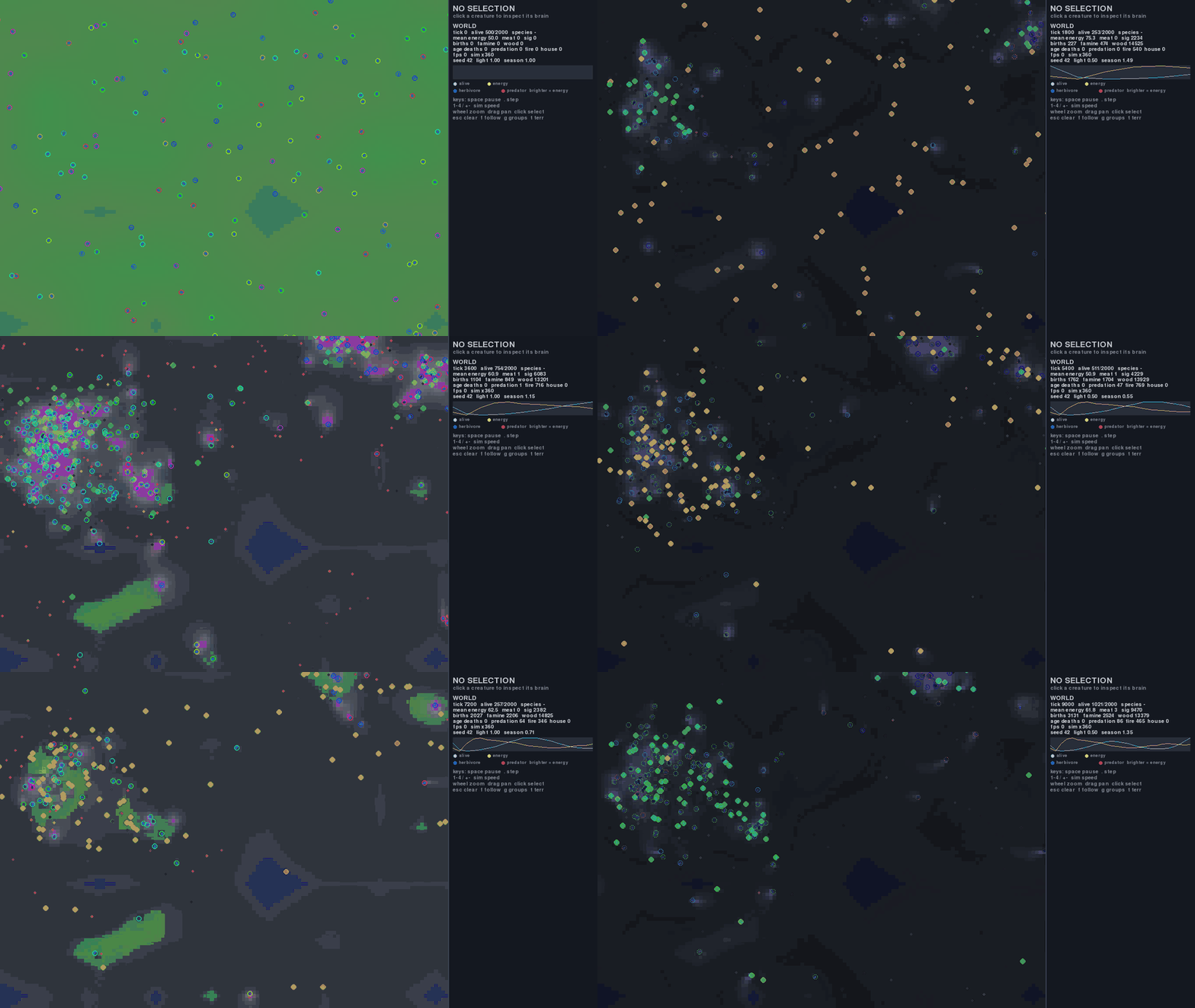
A 2D ecosystem where neural creatures evolve by natural selection — there is no fitness function anywhere. Creatures survive on energy alone; predation, flocking and herding are never programmed, they either emerge from selection or they don't, and the repo publishes both outcomes.
- Small MLP brains (~450 parameters per creature) plus evolvable body traits.
- 2000+ creatures at 30+ ticks/s on an i5-8265U — NumPy + Numba, no GPU, no deep-learning framework.
- Bit-exact determinism (same seed → same world), spatial hash neighborhood, 311 tests covering conservation, reproduction and save/load.
- Built in 25 documented stages with opencode; every mechanism ships with a pre-registered experiment and multiple seeds.
pip install -e ".[render,dev]"
python run.py --seed 42                 # windowed viewer
python run.py --seed 42 --headless --ticks 5000 --stats s42.npz
pytest -q
Repository · README (EN) · README (PT-BR)
Conway-s — Conway's Game of Life on the GPU
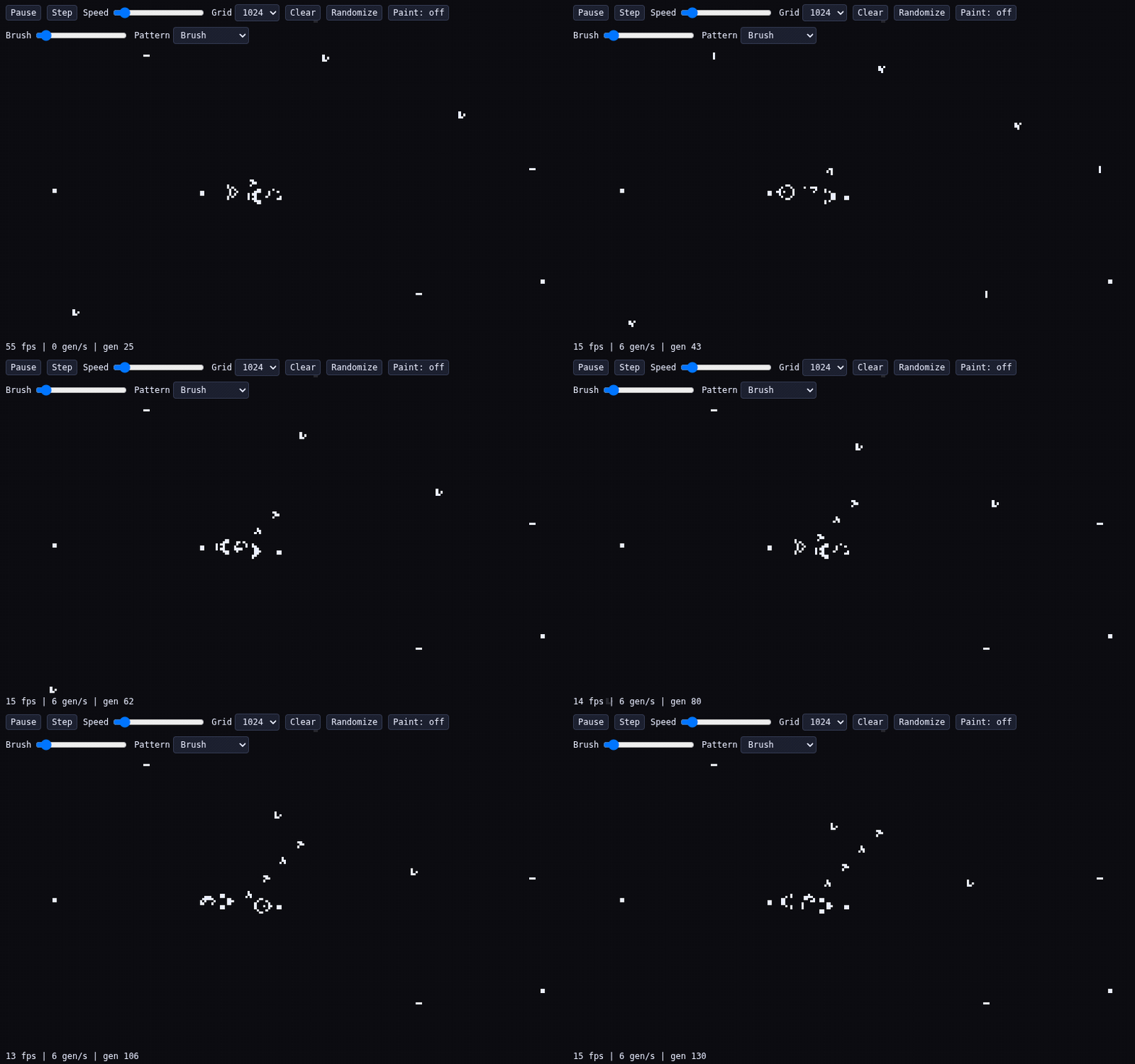
The classic B3/S23 rule, reimplemented for fun in the hardest way I could think of: the whole simulation inside the GPU.
- The rule runs in a WebGL2 fragment shader with ping-pong textures (1 texel = 1 cell) — grids up to 4096² = 16.7 million cells.
- Zero allocations and zero GPU readback in the render loop; plain HTML + JavaScript, no build step, no runtime dependencies.
- 117 headless checks (Playwright + Chromium): bit-exact GPU↔CPU parity, canonical Gosper gun goldens, determinism across loads.
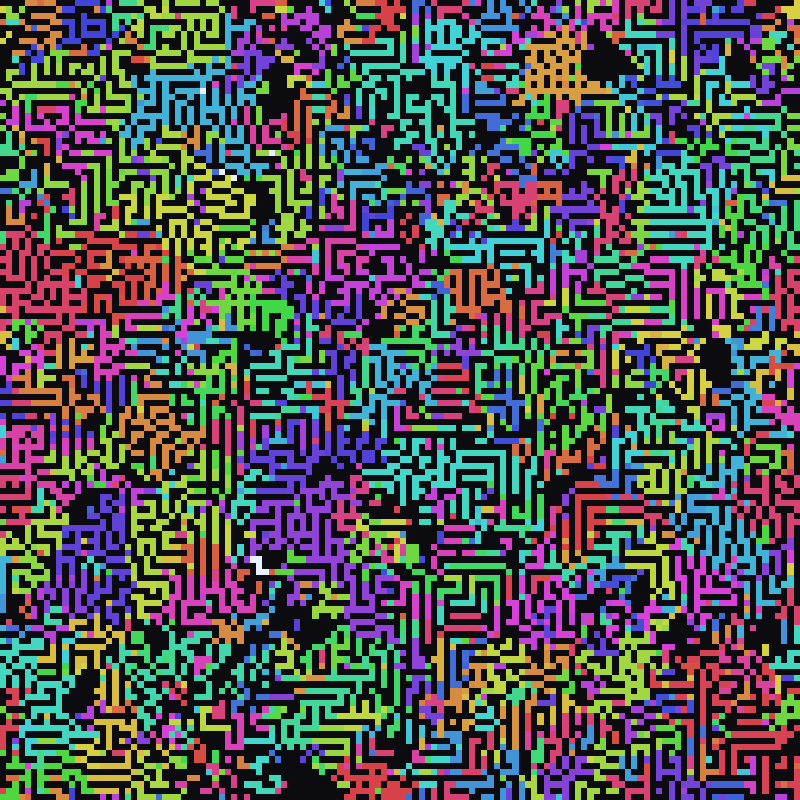
- Beyond the classic rule: per-cell genomes, mutation → colored lineages, frequency-dependent selection, ecology flags and a novelty explorer.
python3 -m http.server 8000    # ES modules require HTTP
# open http://localhost:8000/?demo=1&size=128gt-agent — stage-driven development as GitHub issues
An opencode agent that turns a project roadmap into chained GitHub issues: one issue per stage, linked with native GitHub dependencies, closed only when checked criteria and passing tests and a clean working tree happen together.
- 13 modes: kickoff, plan, verify, next, skip, reopen, retro, status…
- It never edits code or commits — planning and building stay separated on purpose, so the gate cannot be gamed.
- Structural tests run on Node's built-in test runner.
| Project | Description | Stack | Live |
|---|---|---|---|
| Barber Shop API | Scheduling backend: Argon2/JWT login, conflict-safe bookings, no backdated slots | FastAPI · PostgreSQL · Pydantic · Pytest | docs |
| Medsync API | Medical clinic management API, built to learn Docker & Docker Compose | FastAPI · PostgreSQL · Docker · Pytest | docs |
| Dev Journey | Web app to track everyday things | FastAPI · PostgreSQL · Docker | site |
- task-manager-cli-python — CLI task manager: CRUD, filters and JSON persistence.
- biblioteca-python — book library management (register, search, lend, return).
- Calculadora-Python — where I started.