


Data Science | Applied AI | Mining & Geospatial Analytics | Healthcare Analytics
Medical Technologist specializing in MRI, with a bachelor's-level degree in Applied Engineering (Informatics) and currently completing a Master's program in Data Science at Universidad de Santiago de Chile (USACH).
I develop applied analytics projects that combine domain knowledge, statistical reasoning, machine learning, geospatial analysis, data engineering, and reproducible software practices.
My current public portfolio spans GeoAI and mining analytics and healthcare analytics, with additional applied data science projects being progressively curated for publication.
Explore saved scientific results without installing Python. View results opens a read-only notebook renderer, while GitHub notebook opens the source and saved outputs in the repository. These links show previously saved outputs, not live computation.
| GeoAI laboratory | Rendered results | Source and outputs |
|---|---|---|
| LAB01A — Coordinate foundations | View results | GitHub notebook |
| LAB01B — Cross-zone CRS analysis | View results | GitHub notebook |
| LAB02 — Spatial exploratory analysis | View results | GitHub notebook |
| LAB03 — Spatial cross-validation | View results | GitHub notebook |
| LAB04 — Geochemical CoDA | View results | GitHub notebook |
| LAB05 — Mineral prospectivity | View results | GitHub notebook |
| LAB06 — Explainable GeoAI | View results | GitHub notebook |
Important: These are previously saved outputs, not live execution sessions. The experiments use synthetic data and have documented validation boundaries. LAB04 links to the explicitly executed notebook; its separate source-only notebook has no saved outputs. To reproduce a workflow, consult the repository's environment, data, and execution instructions.
If the external notebook viewer is unavailable, try the corresponding GitHub notebook link.
These notebooks in the separate mining-analytics repository also contain saved execution results.
| Mining laboratory | Rendered results | Source and outputs |
|---|---|---|
| LAB01A — Coordinate foundations | View results | GitHub notebook |
| LAB01B — Cross-zone CRS analysis | View results | GitHub notebook |
| LAB02 — Spatial exploratory analysis | View results | GitHub notebook |
| LAB03 — Spatial cross-validation | View results | GitHub notebook |
| LAB04 — Geochemical CoDA | View results | GitHub notebook |
All three TELCO notebooks now have saved, publicly inspectable outputs. The EDA satisfaction-score chart includes a horizontal x-axis-label presentation fix.
| TELCO notebook | Rendered results | Source and outputs |
|---|---|---|
| 01 — Data quality and EDA | View results | GitHub notebook |
| 02 — Modeling | View results | GitHub notebook |
| 03 — Interpretation | View results | GitHub notebook |
WDBC uses a different publication contract from the 15 executed notebooks above: the research notebook is intentionally source-only, and its eight frozen evidence inputs are not distributed. The saved scientific results are available as a read-only, publicly hosted HTML report, not as an executable notebook or clinical application.
| WDBC resource | Public access | Purpose |
|---|---|---|
| Evidence-first landing | Open landing | Study scope, two verified figure previews and methodological cautions |
| Frozen visual report | View scientific report | Five original figures, scientific tables, methods and limits |
| Research notebook | Read source on GitHub | Methodology and audited read-only reporting logic, without saved execution outputs |
Research boundary: development-only WDBC benchmark and probability calibration; not independent clinical validation, a diagnostic system or medical-device software.
A reproducible laboratory portfolio applying geospatial data science, spatial validation, compositional data analysis, machine learning, and GeoAI methods to mineral exploration problems.
Current public milestone: v0.2.0
Completed
- LABORATORY 00 - Engineering & GeoAI Environment
- LABORATORY 02 - Spatial Exploratory Data Analysis
- LABORATORY 03 - Spatial Cross-Validation
- LABORATORY 04 - Geochemical Compositional Data Analysis
- LABORATORY 05 - Mineral Prospectivity Mapping
- LABORATORY 06 - Explainable GeoAI
In progress
- LABORATORY 01 - Geospatial Python Foundations
- LABORATORY 01A - Coordinate Foundations: completed and validated
- LABORATORY 01B - Cross-Zone CRS Analysis: completed and validated
Planned
- LABORATORY 07 - Uncertainty Quantification
- LABORATORY 08 - Remote Sensing
- LABORATORY 09 - Deep Learning for GeoAI
- LABORATORY 10 - Graph & Multimodal GeoAI
The v0.2.0 project checkpoint includes 163 passing automated tests, signed milestone commits, a signed release tag, pre-commit quality controls, and full-history secret scanning with Gitleaks.
LABORATORY 05 demonstrates a leakage-aware mineral prospectivity workflow using spatial cross-validation, pooled out-of-fold evaluation, out-of-sample ranking, and a sealed hidden-oracle evaluation.
Under the frozen synthetic experiment, the selected prospectivity model achieved useful hidden-deposit enrichment while prioritizing substantially less than the complete candidate area.


A reproducible public healthcare analytics portfolio project using synthetic radiology workflow data to demonstrate RIS/PACS operational analytics, reporting latency, workflow analysis, data quality, management-oriented visualization, and cross-platform software quality controls.
The live dashboard is deployed on Streamlit Community Cloud and contains synthetic data only.
Explore Healthcare MLOps Benchmark
Published development-only research notebook on Wisconsin Diagnostic Breast Cancer (fine-needle aspirate features, not mammography): nested cross-validation, out-of-fold evaluation, and probability calibration. Includes a static visual report. The frozen research inputs are not included in this minimal public release; results are not externally validated and are not intended for clinical decisions.
Open live report landing | View scientific HTML report | Research notebook (source only)
Explore completed TELCO Churn Analytics
Public synthetic-data case study of leakage-aware churn modelling, temporal validation, probability calibration, model comparison, and automated quality controls. The final portfolio integration was completed on 19 October 2026. Model performance describes the synthetic benchmark only and is not evidence of production performance.
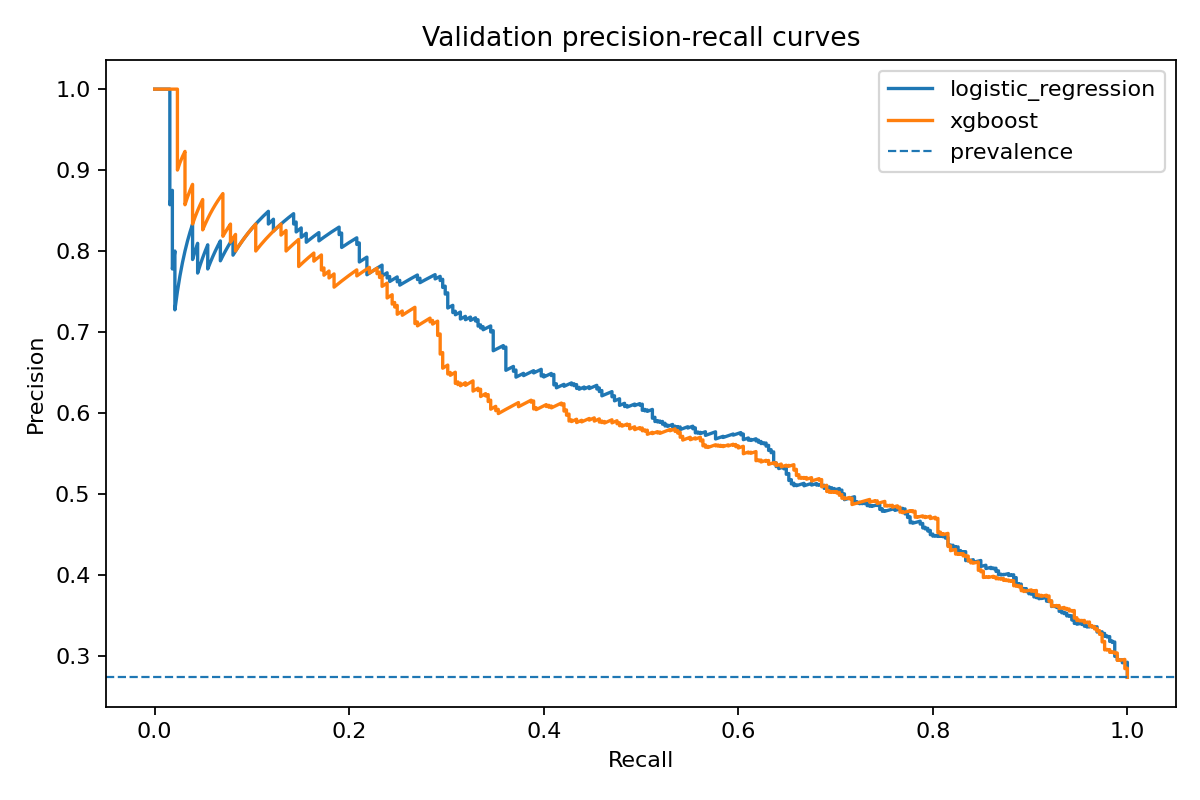
The three TELCO portfolio notebooks are published on main with executed outputs (12 saved outputs including 3 PNG figures across the notebooks). The figure above remains a separately version-controlled validation plot. The notebook outputs describe the frozen synthetic benchmark only, not production telecom performance.
Executive analytics and campaign-ideation showcase in preparation. The public edition will retain approved executive views and high-level methodological explanations while excluding private models, sensitive details, detailed experimental tables, and internal validation material. Publication status: curation, privacy, and public-scope review pending. Public repository link: not yet available.
Data Science
Python | R | pandas | Polars | NumPy | scikit-learn | Jupyter
Geospatial Analytics
GeoPandas | Shapely | PyProj | Rasterio
Engineering & Quality
Git | GitHub | Conda | pytest | pre-commit | GitHub Actions | Gitleaks
Data & Analytics Engineering
SQL | DuckDB | data pipelines | analytical validation | reproducible workflows
Spatial analysis, geospatial data engineering, spatial machine learning, compositional geochemistry, mineral prospectivity, and reproducible GeoAI workflows.
Applied analytics for medical imaging, operational performance, RIS/PACS systems, and healthcare information workflows, informed by professional experience in MRI and medical imaging.
Statistical modelling, machine learning, reproducible experimentation, analytical pipelines, and interpretable model development across applied domains.
I focus on analytical work that is reproducible, auditable, and scientifically defensible.
This includes:
- validating assumptions before increasing model complexity;
- preventing data leakage, including spatial leakage;
- separating exploratory analysis from reusable analytical components;
- comparing advanced methods against interpretable baselines;
- using automated testing and explicit quality gates where appropriate;
- maintaining traceable version control and signed milestones;
- validating important changes through pull requests;
- communicating uncertainty, limitations, and methodological assumptions explicitly.
The next planned GeoAI laboratory is LABORATORY 07 - Uncertainty Quantification.
Additional public projects in machine learning and applied data science will be added progressively after methodological, security, and publication review.